7 Ways to Boost Organic Traffic Without Hiring Writers
You don’t need a big content team to grow your organic traffic. By leveraging automation tools, technical SEO, and existing content, you can achieve impressive results while cutting costs. Here’s how:
- Automate content creation with tools like LazySEO, reducing costs from $500/article to as little as $1.30/article.
- Fix technical SEO issues like crawl errors and slow site speed for quick ranking improvements.
- Update and repurpose old content to regain traffic and improve rankings.
- Use automated keyword research to find low-competition opportunities.
- Build better internal links to improve site navigation and boost page rankings.
- Optimize for SERP features like featured snippets to increase visibility.
Focusing on these strategies can save you time and money while driving more traffic. Let’s dive into the details.
::: @figure 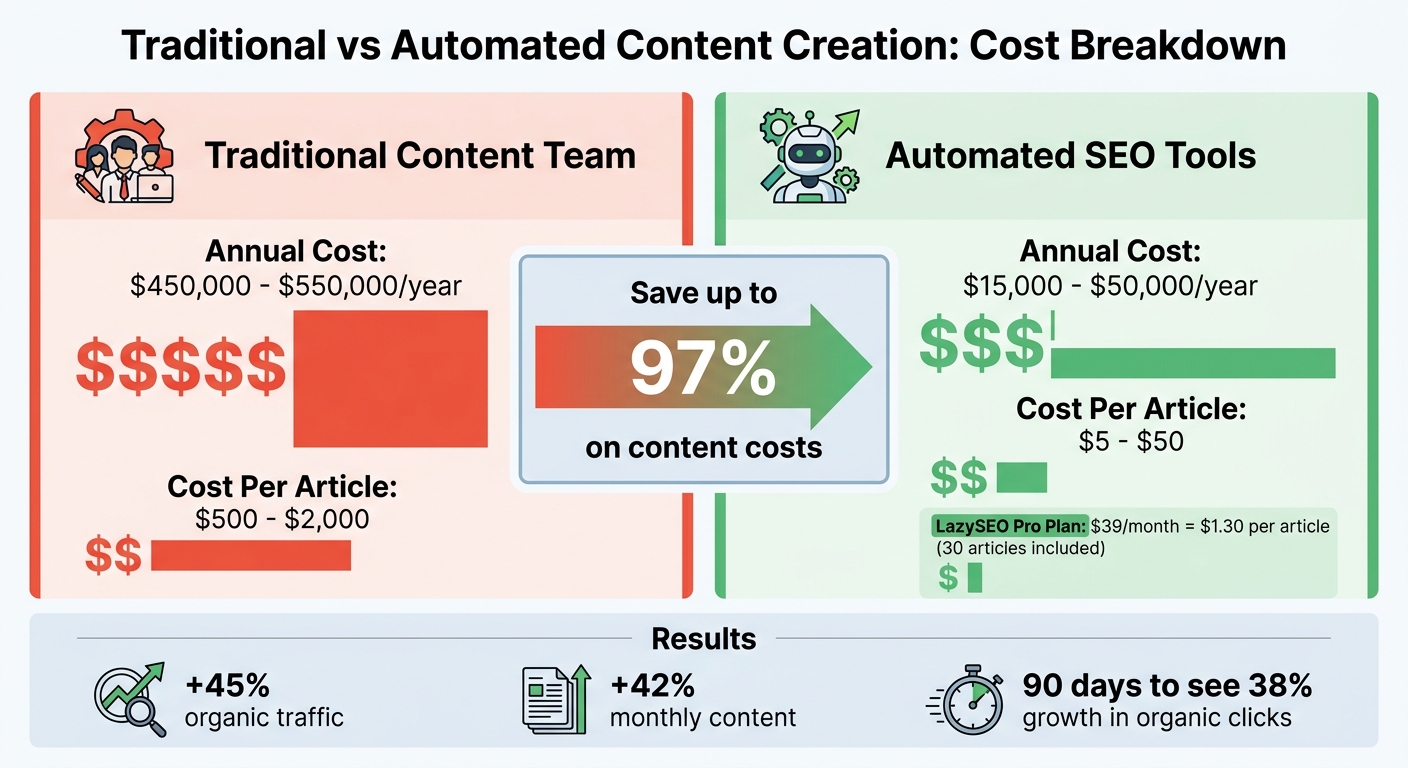 {Cost Comparison: Traditional Content Teams vs Automated SEO Tools}
:::
{Cost Comparison: Traditional Content Teams vs Automated SEO Tools}
:::
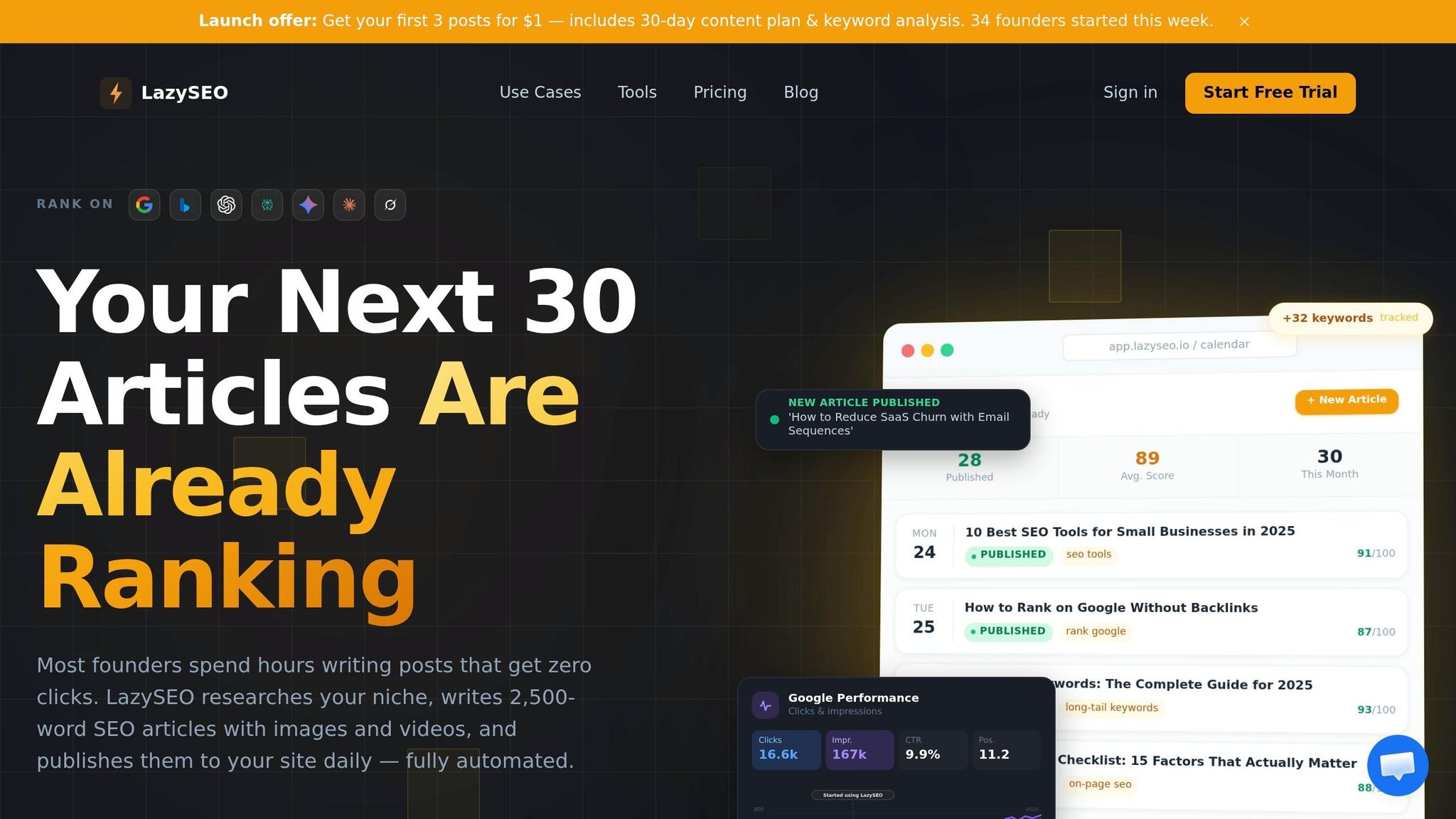
1. Use LazySEO for Automated SEO Content Creation
Cost Savings
Automating content creation can slash your annual expenses. While traditional content teams cost anywhere from $450,000 to $550,000 per year, automation platforms bring that down to about $15,000–$50,000[9]. The savings per article are just as impressive: human-written pieces typically cost $500–$2,000, but with AI, that drops to $5–$50 per article[9]. LazySEO’s Pro plan is priced at $39 per month and includes 30 SEO-optimized articles, which means you’re paying just $1.30 per article.
Automation Features
LazySEO simplifies the entire content creation process. It scans your site, identifies rankable keywords using automated gap analysis, and generates fully optimized articles that are published directly to your CMS. The platform integrates with WordPress, Webflow, Ghost, Framer, and Shopify through a one-time API connection[4][7]. Additional features include built-in SERP analysis, internal linking, and multilingual content generation. This eliminates the need for tedious tasks like managing spreadsheets or manually uploading content, saving you hours every week. With these tools, you can shift your focus to strategy while LazySEO handles the heavy lifting.
Boosting Organic Traffic
AI-driven SEO workflows have been shown to increase organic traffic by 45% and improve monthly content output by 42%[8][9]. For example, a mid-market B2B SaaS publisher using similar automation saw a 38% growth in non-brand organic clicks within just 90 days and secured featured snippets for three key pillar pages[4]. Another company reported a 63% jump in organic leads over six weeks by optimizing for AI-friendly platforms like ChatGPT and Gemini[1].
Simple Setup
Getting started with LazySEO is straightforward. Connect the platform to your CMS and link it to data sources like Google Search Console. LazySEO then takes over, identifying ranking opportunities and creating a content calendar. You can test the workflow with a $1 seven-day trial, which includes two AI-generated articles. The platform streamlines the entire process, from keyword research to publishing, without the need for exporting files or manually scheduling posts[7]. This smooth setup makes it easy to integrate LazySEO into your operations and opens the door to further SEO improvements.
sbb-itb-851db2b
2. Optimize Technical SEO Elements
Cost-Effectiveness
When it comes to maximizing your SEO efforts, technical fixes are a smart investment. Unlike creating new content - which can take three to nine months to rank - technical optimizations can deliver noticeable results in just two to six weeks[13]. Plus, you're working with content you already have, which means no need to start from scratch. For example, fixing crawl errors often takes only one to three hours[13]. And here's a standout stat: 50% of marketers say SEO offers the best return on investment compared to other marketing strategies[6].
Automation Capabilities
Automation tools make technical SEO much easier to manage. Platforms like Semrush, Screaming Frog, and Sitebulb can automatically crawl your site, flagging issues like broken links, 404 errors, duplicate title tags, and redirect chains[12][13]. These tools are budget-friendly too - Screaming Frog or Sitebulb cost less than $250 annually[13]. AI tools take it even further by converting FAQs into schema markup or using indexing APIs to speed up content discovery by search engines by 30% to 50%[4][11]. Need to update title tags or meta descriptions at scale? AI can handle that too, focusing on keywords ranking in positions 4–10[11][13]. Setting up automated weekly crawls ensures you catch and fix issues before they impact your rankings[13]. These tools allow you to focus on strategic improvements while they handle the routine checks.
Impact on Organic Traffic
The numbers speak for themselves. Fixing crawl errors and broken links ranks as an 8 out of 10 in terms of impact[13]. Adjusting title tags for "striking distance" keywords - those in positions 4–10 - can boost click-through rates by 20% to 35%, even without improving your actual ranking[13]. Adding schema markup? That can lift CTR by 10% to 30%[4]. And improving Core Web Vitals from "poor" to "good" can lead to a 3% to 7% ranking improvement for competitive searches[13]. Addressing redirect chains is another quick win: every additional hop in a chain reduces PageRank by about 15%, so cleaning these up helps preserve your site's authority[13].
Ease of Implementation
The best part? These fixes are simple and don't require advanced technical skills. Start with Google Search Console to identify pages ranking in positions 4–10, then rewrite their title tags to include the primary keyword within the first 30 characters[13]. Speed up your site by compressing and lazy-loading images - slow-loading pages are often the culprit behind poor performance[13]. Use tools to locate and repair broken links, especially on pages with inbound links that drive authority[13]. Most of these tasks take less than an hour per page, and the results often show up within weeks instead of months[13]. It's a quick and efficient way to enhance your site's performance.
How I built an AI SEO Automation to Rank #1 on Google and ChatGPT (AI Agent + Autoblogging)
::: @iframe https://www.youtube.com/embed/JLBp3tB2P1E :::
3. Repurpose Existing Content
Repurposing your existing content is a smart way to drive organic traffic without starting from scratch.
Cost-Effectiveness
Reworking what you already have saves money. Instead of hiring new writers or pouring funds into ad campaigns, you’re making the most of content that’s already been created. Jessica Foster, Founder and Lead SEO Strategist at The Web Edit, sums it up perfectly:
"Work smarter, not harder: a survival tactic for content marketers" [15]
The best part? This content already has domain authority and backlinks, so you’re not building from the ground up. Many repurposing techniques require little to no budget - just time and a clear strategy [15].
Automation Capabilities
Automation tools can make repurposing even easier. For instance, Tailwind can automatically re-share Pinterest Rich Pins to various boards over time, turning a single piece of content into a long-term traffic generator. One business, without publishing anything new for a year, managed to get 15,000 impressions and 464 clicks in just 30 days using this approach [15].
AI tools like ChatGPT and NotebookLM also help streamline this process. For example, in early 2026, an arborist client of The Web Edit used NotebookLM to consolidate blog and service page content into a centralized FAQ page. This move not only improved efficiency but also cut down on repetitive customer inquiries [15].
Impact on Organic Traffic
Repurposing content doesn’t just save time - it can also significantly boost traffic. Updating old material triggers Google’s "Query Deserves Freshness" system, which prioritizes recently refreshed content. Louise Linehan, Content Marketer at Ahrefs, explains:
"Google has a search ranking system called 'query deserves freshness' where it prioritizes content that has been recently published or updated" [17]
The results speak for themselves. URLs cited by AI assistants are, on average, 25.7% fresher than those found in traditional search results [17]. Ahrefs, for instance, revamped a 2018 blog post on link reclamation in August 2024. The original post never surpassed 350 organic visits per month, but the refreshed version tripled its traffic shortly after its update [17]. Similarly, in April 2025, HubSpot updated their "Competitive Analysis" blog post, boosting its visibility in AI Overviews from 151 citations to 476 - a threefold increase [17].
Ease of Implementation
Getting started doesn’t have to be complicated. Simple updates - like tweaking titles, adding fresh statistics, or updating internal links - can yield impressive results without requiring a full rewrite [17]. For example, adjusting article titles to target specific groups (e.g., changing "Marketing Tips" to "Marketing Tips for Lawyers") can increase click-through rates by 20% to 50% [15].
You can also reformat high-performing blog posts into downloadable PDFs or infographics to appeal to different types of learners [16][18]. Another effective tactic is enabling Pinterest Rich Pins using Open Graph or Schema markup. Once set up, tools like Tailwind can distribute these pins across multiple boards, further extending your content’s reach [15]. These small, manageable steps can help maximize the impact of your existing content across various platforms.
4. Use Automated Keyword Research and Targeting
Automation Capabilities
Automated keyword research tools have revolutionized SEO by taking over tasks that used to demand hours of manual effort. These tools leverage AI to analyze thousands of keywords simultaneously, grouping them by topic and user intent to uncover content gaps you might have missed [20]. They also integrate with platforms like Google Search Console and Analytics to identify "low-hanging fruit" - keywords where your site already gets impressions but has room to climb in rankings [10].
The time savings are huge. As Averi Resources explains:
"What a single SEO specialist might spend a week accomplishing manually can be generated in an afternoon." [20]
For instance, LazySEO automates keyword scanning, identification, and even brief generation, seamlessly connecting keyword discovery with your broader content strategy. This makes automation an essential part of modern SEO efforts.
Cost-Effectiveness
AI tools don’t just save time - they save money. By producing keyword research and content drafts in minutes, they allow smaller teams to compete with larger ones [20]. Instead of hiring additional specialists, you can rely on automation to run continuously. One example: In early 2026, a Workfx AI client grew their organic traffic to 1,132 users in just three months - without building a dedicated marketing team [1].
With AI, content production can increase by 3–5× without adding more staff, delivering substantial cost savings [20].
Impact on Organic Traffic
The numbers highlight why automated tools are a game-changer. Organic search accounts for 53% of all website traffic, far outpacing paid ads [1]. Landing the top spot on Google results in 28.5% of all clicks - nearly double the 15.9% earned by the second position [1]. A small SaaS team, for example, saw a 40% increase in relevant traffic within weeks after switching to an AI-powered research engine [21].
These tools are especially effective at identifying long-tail keywords, which now make up about 70% of all search traffic [22]. In one case, a B2B company experienced a 63% boost in organic leads over six weeks after using automated optimization to get their content recommended by platforms like ChatGPT and Gemini [1].
Ease of Implementation
The best part? Getting started with automation is simple. Most tools are designed for ease of use, offering one-click integrations with existing analytics platforms to streamline the process from data collection to content planning [10]. You can set filters for keyword difficulty (e.g., under 30) and search volume thresholds tailored to your niche [21].
You can even schedule automated workflows to run nightly, delivering fresh, high-intent keywords daily. Tools like LazySEO take care of the entire process - from keyword discovery to content creation and publishing - making implementation a breeze [21].
5. Update and Refresh Old Content
Cost-Effectiveness
Refreshing old content can stretch your budget further than creating brand-new articles. Updating an existing page usually costs between $50 and $150, while producing new content can run from $200 to $500 [24]. Plus, boosting an existing page from position six to position two costs ten times less than trying to rank a fresh piece [23].
The Seo Engine Editorial Team emphasizes this point:
"A 50-page blog that skips content updates for one year loses the equivalent traffic of 25-30 net-new articles - making 'publish and forget' the most expensive content strategy possible." [24]
Just one well-planned update can bring back 40–80% of lost organic traffic within a month [24]. This makes refreshing content not only cost-effective but also a smart way to regain rankings and traffic.
Impact on Organic Traffic
Content decay is a challenge - pages left untouched often see a decline of 8–12% in traffic per quarter [24]. But here's the good news: updated pages can recover an average of 52% of lost rankings within 45 days, and many regain 40–80% of lost traffic within 30 days [24].
For example, in August 2024, the Ahrefs content team, led by Louise Linehan, completely revamped a 2018 blog post on "link reclamation." Before the update, the post averaged about 350 organic visits per month. After the refresh, traffic tripled [17]. Similarly, HubSpot updated its "Competitive Analysis" article in April 2025, and its visibility in AI Overviews soared from 151 responses to 476 - a 3× increase in AI visibility [17].
Automation Capabilities
Automation makes refreshing content even easier. Modern tools track rankings and traffic, automatically identifying when a page's performance drops below a certain threshold. These tools then add the page to a refresh queue [25]. AI can also analyze your content against competitors, flagging missing subtopics or questions that could improve your post [25][26].
A combined approach works best: let AI find the gaps while humans refine the updates for accuracy [24]. Tools can also monitor your content library for outdated stats, alerting you when new data becomes available [25]. Teams that update 5–8 pages per week instead of tackling large batches see 31% better ranking recovery [24].
Ease of Implementation
Start with quick and simple updates. A "quick fix" might take just 30–45 minutes - update a couple of stats, tweak the meta description, and add one internal link. This approach restores rankings in about 40% of cases [24]. For pages needing more work, a "moderate update" takes 2–4 hours and could include adding 300–600 words, reorganizing headings, or adding a FAQ section [24].
Focus on pages ranking in positions 5–15 for high-volume keywords; these are your best opportunities for improvement [23]. After making updates, use the Google Search Console inspection tool to request indexing and get the page crawled immediately [23]. And remember - never change the URL when updating. Doing so wipes out your backlink equity [24].
6. Build Internal Linking Structures
Creating a solid internal linking structure is a smart way to improve your site's visibility. It’s a strategy that focuses on connecting your existing pages, boosting discoverability without the need for additional spending.
Cost-Effectiveness
Internal linking is a budget-friendly tactic that delivers impressive results. For instance, a B2B SaaS company with over 400 pages saw a 40% jump in organic traffic in less than four months just by reorganizing its internal links [31]. Another example? Adding 47 contextual links helped 12 pages move from page two to page one in just 14 days, resulting in a 187% increase in organic traffic [33]. When compared to the costs of creating new content or running paid advertising, internal linking proves to be a high-return investment. It’s an excellent way to get more value from your existing content.
To make this process even smoother, automation tools can take much of the heavy lifting off your plate.
Automation Capabilities
Modern SEO tools powered by natural language processing can analyze thousands of pages and recommend link opportunities based on semantic relevance, not just keywords [27][28]. Tools like Claude Code can even create an entire internal linking system for the price of an API subscription - an affordable alternative to SEO platforms that often cost around $200 per month [32]. These tools can identify orphan pages, calculate click depth, and suggest anchor text, leaving you with just the final approval [29][30]. Some platforms even use a "drip" strategy, gradually adding links to older posts to signal freshness to Google. Teams using this approach report ranking improvements of 12–18% for optimized pages within weeks [27].
With automation, you can make noticeable improvements quickly and efficiently. For more advanced techniques, explore our AI SEO guides.
Impact on Organic Traffic
John Mueller, Senior Search Analyst at Google, highlights the importance of internal linking:
"Internal links help us a lot … probably one of the biggest things you can do on a website." [28]
The results back this up. HubSpot reported a 50% increase in organic traffic over six months after adopting a topic cluster internal linking model [31]. Similarly, another site saw a 25% lift in organic clicks within 60–90 days by addressing click depth and orphaned pages with AI tools [27]. Neglecting internal links can have consequences too - pages with fewer than three internal links may experience a 60% drop in indexing rates [33].
Ease of Implementation
Getting started with internal linking is easier than you might think. Begin by identifying orphan pages using tools like Google Search Console or a website crawler. Focus on pages ranked between 6–20 in search results and add 3–5 contextual links from high-authority pages. This simple update can push these pages to the first page of search results in just 2–4 weeks [31][33]. To maximize impact, place your links within the first 200–300 words of the content. And unlike external links, internal links benefit from using exact-match, keyword-rich anchor text, which Google explicitly recommends for providing context [33][31].
7. Use SERP Analysis for Content Optimization
Building on earlier strategies, SERP analysis allows you to refine your content by learning directly from the top-ranking pages on Google. This approach uses live data to identify what’s working, making it an efficient way to optimize your content without relying on expensive tools.
Cost-Effectiveness
Manually conducting SERP analysis can replicate about 80% of the insights offered by premium tools like Clearscope or Surfer SEO, which cost between $89 and $200 per month [40]. Instead of relying on these paid platforms, you can use Google’s own features like Autocomplete, "People Also Ask" boxes, and "Related Searches" to gather real-time data [40][41]. Considering that the top result on a SERP enjoys a 27.6% click-through rate and first-page results capture 91.5% of all organic traffic, studying these pages can save you both time and money [41][14]. This method eliminates the need for costly research tools or dedicated teams.
Automation Capabilities
AI tools and large language models (LLMs) can simplify SERP analysis by categorizing keywords based on intent - whether navigational, informational, commercial, or transactional. These tools can also analyze the top-ranking pages for recurring patterns in headings, themes, and answers, helping you identify subtopics your content may lack [37][38][36]. Additionally, automated alerts can notify you of ranking drops of three or more positions, prompting immediate updates to keep your content competitive [36]. AI tools can even generate structured data, like FAQPage or HowTo schema, which can help secure featured snippets. These snippets often consist of 40–60 word definitions, making them a valuable opportunity for visibility [36][37].
Impact on Organic Traffic
Being cited as a source in AI-generated overviews can have a noticeable impact on your traffic. For instance, sites featured in these overviews have seen their click-through rates increase from 0.6% to 1.08% [34]. Brands that adopt Generative Engine Optimization (GEO) techniques report an average 40% improvement in visibility within AI-driven search engines [19]. Interestingly, there’s only a 12% overlap between traditional organic rankings and AI search rankings [37]. To increase your chances of being included in AI overviews, format your content with concise, 40–60 word answers immediately following headings and use question-based H2 or H3 tags [34][19][35].
Ease of Implementation
Getting started with SERP analysis is straightforward and requires minimal tools. Open an incognito browser, search your target keyword, and review the top five results to identify recurring themes and headers [40]. Use a systematic approach to uncover long-tail queries by typing your seed keyword followed by each letter of the alphabet (e.g., "SEO a…", "SEO b…") [10]. Check "People Also Ask" boxes for question phrases to use as headers and explore "Related searches" at the bottom of the SERP for additional topic ideas [41][10][39]. Finally, refresh high-performing content that’s over a year old to signal relevance to both traditional search engines and AI algorithms [34][19].
Conclusion
Boosting organic traffic without relying on a team of writers is not only doable but also a smart way to save on costs. By combining automation with well-thought-out strategies, you can create a self-sustaining system where each tactic strengthens the others, leading to steady growth over time [5]. For example, technical SEO and internal linking lay the groundwork for search engines to easily navigate your site, while tools like AI-driven content creation and keyword targeting ensure you capture long-tail search traffic [1][2].
Organic search continues to be a powerhouse for driving visitors. Did you know companies with blogs see 57% more visitors and 67% more leads compared to those without? [1] This proves that with the right mix of automation and optimization, you can achieve significant results without the need for a large team.
Here’s a practical tip: focus on small, immediate wins before scaling up. For instance, improving pages ranked in positions 6–10 to the top five can increase click-through rates from 3.5% to over 12% [2]. Quick adjustments like adding internal links (using an internal link analyzer) or refreshing underperforming content can make a noticeable difference. Fun fact - updating existing content delivers 43% of the traffic gains of new content but takes only 23% of the effort [2].
"Organic traffic is a flywheel, not a shortcut."
- Ian Spencer, B2B Growth Specialist [5]
To future-proof your efforts, blend traditional SEO with newer techniques like Generative Engine Optimization. This approach not only keeps your strategy current but also positions your content for visibility on emerging AI-driven platforms [1]. Tools like Google Analytics 4 and Google Search Console are essential for monitoring engagement and rankings, helping you track progress and refine your approach [3][2].
FAQs
::: faq
How do I know which pages to update first?
To figure out which pages need attention first, use tools like Google Search Console or Google Analytics to review your website's performance. Pay close attention to pages showing a drop in traffic or weak engagement metrics. Start by pinpointing underperforming URLs, then refresh these pages with better content, improved relevance, and stronger SEO. This focused strategy can help you regain and boost traffic more effectively. :::
::: faq
What technical SEO fixes usually move the needle fastest?
When it comes to quick wins in technical SEO, a few fixes can deliver noticeable results in a short amount of time. These include resolving indexing issues, boosting site speed, and ensuring your website is fully crawlable by search engines. Implementing these changes often leads to traffic increases of 15–35% in just 4–8 weeks, making them a smart move for anyone looking to see rapid improvements. :::
::: faq
How can I measure if AI content is actually helping SEO?
To figure out if AI-generated content is helping your SEO, keep an eye on some important metrics like organic traffic, search rankings, and how visible your site is in search engine results pages (SERPs). Pay attention to shifts in traffic numbers, keyword positions, and how often your content lands in featured snippets. Using tools designed to track SERP performance and measure content impact can give you valuable insights. By consistently reviewing this data, you'll see if your AI-powered efforts are improving rankings and driving more visitors to your site. :::