
10 Keyword Research Tips for Small Business Owners
Keyword research is essential for small businesses looking to improve their online presence without spending heavily on ads. It helps you identify the exact search terms your customers use, driving targeted traffic to your site. Here's a quick summary of the article's key tips:
- Know Your Audience: Understand their challenges and language.
- Start Broad, Then Narrow: Use general topics to find specific, long-tail keywords.
- Target Low-Competition Keywords: Focus on less competitive terms for quicker rankings.
- Use Free Tools: Leverage tools like Google Keyword Planner and Search Console.
- Google's Auto-Suggest: Discover real-time search terms with autocomplete.
- Analyze Competitors: Study their keywords to find content gaps and opportunities.
- Focus on Local Keywords: Use location-specific terms for local search visibility.
- Organize Keywords: Group by topics and search intent for better content planning.
- Write Naturally: Integrate keywords seamlessly into your content.
- Track Performance: Regularly monitor keyword rankings and adjust strategies.
These tips help you attract the right audience, improve visibility, and drive meaningful results for your business. Let’s dive deeper into each strategy.
::: @figure 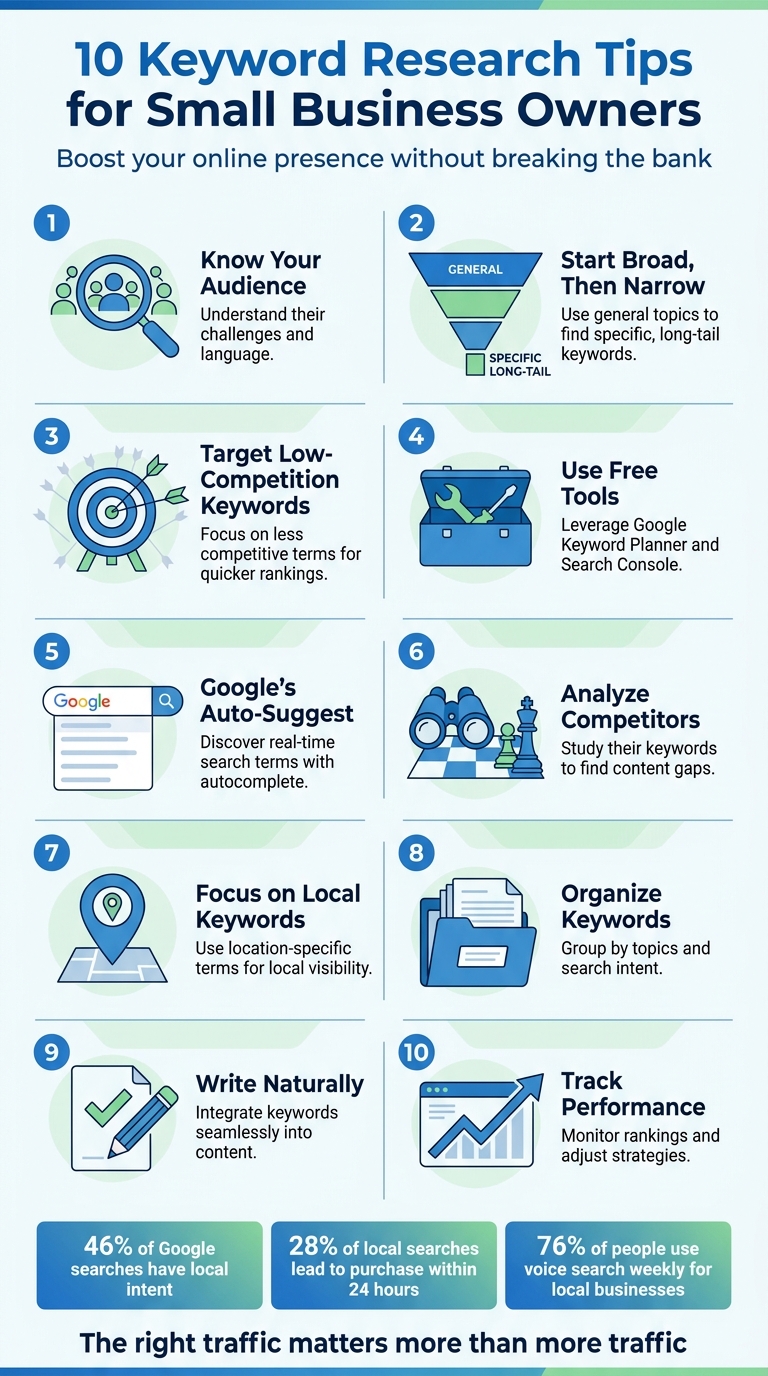 {10 Keyword Research Tips for Small Business SEO Success}
:::
{10 Keyword Research Tips for Small Business SEO Success}
:::
How to Find SEO Keywords for FREE – A Guide for Small Businesses
::: @iframe https://www.youtube.com/embed/-q4TthkSUCw :::
1. Understand Your Audience and What They're Searching For
The first step to effective keyword research? Start with your customers. It's about understanding their challenges and the language they use to describe them.
"The best keyword research starts with your customers, not a keyword tool." - Wouter van der Meij, Entrepreneur and SEO Specialist [2]
Think about the exact phrases your customers use when they reach out. For instance, a homeowner isn’t searching for "hydro-jetting services" - they’re typing "clogged kitchen sink" [6]. This distinction is crucial because 46% of all Google searches have local intent [6]. If your keywords don’t match your audience’s language, they simply won’t find you.
Leverage insights from your sales and support teams - they’re often the first to hear how prospects describe their problems [6]. Dive into your Google Business Profile and Yelp reviews for recurring phrases in customer feedback. Also, explore Google’s "People Also Ask" section for your core services to uncover common questions [2].
Here’s a real-world example: When CNN Brasil partnered with NP Digital in 2022 to analyze their audience’s search habits, they achieved a 91% increase in total pageviews, surpassing 1 billion for the year. They also saw a 19% jump in top 10 Google keyword rankings [4]. This success came from aligning their content with what their audience was actively searching for - not from guessing.
Once you understand your audience’s needs, you can move on to refining your keyword strategy by starting broad and narrowing your focus.
2. Start With General Topics and Narrow Down
Kick things off by focusing on broad topics and gradually narrowing them into more specific, long-tail phrases. The goal here isn’t to rank for general terms like "plumbing" or "marketing", but to use them as a starting point to uncover valuable, niche keywords.
Begin by listing the basic terms that describe your products or services. Think of 5-10 seed keywords that reflect your core offerings in simple, everyday language - skip the industry jargon. For example, a bakery owner might jot down "bread", "cakes", and "pastries", while a plumber might start with "drain cleaning", "water heater", and "pipe repair." These broad terms will help you map out your search landscape and identify who your main competitors are [6].
"Keyword research determines who your competitors are and which area of the search landscape you can rank for. Doing keyword research and understanding where your blog or website sweet spot is - that's what gives you rankability." - RankHub Blog [6]
After identifying your general topics, refine them with modifiers to make them more specific. For instance, "tires" can become "best all-season tires", and "bakery" can evolve into "vegan bakery in Brooklyn." Words like "best", "affordable", "emergency", or even location names are great for tailoring your keywords to meet specific customer needs while reducing competition [4]. Google's "related searches" section is another excellent resource for discovering how people are fine-tuning these broader terms [4].
Take it a step further by framing keywords around the actual problems your customers face. Instead of sticking to generic service terms, focus on phrases like "clogged kitchen sink" or "leaking faucet." These are the exact phrases your sales or customer service teams hear regularly, making them highly valuable keywords [6]. This shift from technical language to the words your customers actually use can make a huge difference. Businesses that align their content with customer language tend to stand out, improving both visibility and conversions. This approach lays the groundwork for deeper strategies like competitor analysis and targeting local keywords.
3. Target Keywords With Less Competition
For small business owners, targeting less competitive keywords is a smart way to boost SEO without breaking the bank. Competing for high-volume keywords often means going head-to-head with established brands that have bigger budgets and years of domain authority. Instead, zero in on low-competition keywords - search terms with fewer websites targeting them. This approach gives your business a better chance to rank faster and gain visibility [8].
A key metric to watch is Keyword Difficulty (KD%), which rates how hard it is to rank for a keyword on a scale of 1–100. Keywords with a KD% below 20 or 30 are typically easier for small businesses to target [9]. Some tools even offer Personal Keyword Difficulty (PKD%), which uses AI to assess how challenging a keyword would be specifically for your website, offering a more tailored strategy [8]. When using keyword research tools, set the KD% filter to "Easy" and look for terms with at least 100 monthly searches. This sweet spot balances opportunity with manageable competition [8].
Another tip: aim for keywords with monthly search volumes under 1,000. While these numbers may seem modest, they often represent untapped opportunities for small businesses. Larger companies tend to overlook these keywords, leaving room for you to dominate [9].
"The lower search volume often means your competitors are less likely to target these keywords in their content. This is what makes these keywords lucrative - there's less competition." - Matthew Mace, SEO Content Writer at Surfer [9]
These keywords also tend to attract more qualified leads - people who already know what they want and are closer to making a purchase.
Here’s a hands-on strategy: manually review the top search results for your chosen keyword. If you find outdated content, poorly designed pages, or low-authority websites in the top 10, it’s a strong signal the keyword is worth pursuing [9]. You can also explore niche platforms like Reddit or Quora using search modifiers such as site:reddit.com "your keyword". This tactic can uncover trending questions or topics that keyword tools might miss, often leading to zero-competition opportunities [9].
"Low-competition keywords won't stay that way forever. The sooner you build your list, the more time you have to establish rankings before competition increases." - Luke Harsel, Product-led Content Lead at Semrush [8]
4. Take Advantage of Free Keyword Research Tools
You don’t need a hefty budget to dive into keyword research. There are plenty of free tools that provide valuable insights if you know where to look. Here’s a breakdown of some top options to get you started.
Google Keyword Planner is a fantastic place to begin. By signing up for a free Google Ads account, you gain access to data like monthly search volumes, cost-per-click estimates, and keyword forecasts updated every 7–10 days [11][12]. You can even discover new keywords by entering topics related to your business or using the "Start with a website" feature to analyze competitor sites [11].
"Google Keyword Planner is a free keyword research tool available through Google Ads. With Keyword Planner, you can research keywords, view metrics (like volume, competitiveness, and cost per click), and download keyword data." – Sarah Berry, Lead SEO Consultant, WebFX [11]
Google Search Console is another must-use tool. It helps you identify which keywords are already driving traffic to your site and highlights pages with high impressions but low click-through rates [10].
Google Trends is ideal for spotting seasonal search trends and pinpointing regions where interest in your services is particularly high [10].
For a more specialized approach, check out Keyword Surfer, a free Chrome extension. It displays search volume and related keyword suggestions directly within your Google search results. Similarly, Keyword Tool uses Google’s autocomplete feature to generate long-tail keyword ideas, and it works across platforms like YouTube, Amazon, and eBay [10].
If you’re looking to explore premium options without committing, tools like Semrush offer free plans. These plans allow up to 10 daily queries from their massive database of 22 billion keywords [10].
5. Use Google's Auto-Suggest Feature
Google Autocomplete, also known as Google Suggest, is a straightforward yet powerful tool for keyword research. Found directly in Google's search box, it offers real-time predictions based on popular search queries. These suggestions are shaped by factors like search frequency, trending topics, and even your location[14][13].
Ann Smarty from Smarty Marketing highlights its value:
"Google Autocomplete is one of the most powerful sources of niche questions that your target users routinely type to solve related problems."[14]
To make the most of this tool, start by typing your main keyword into the search box and pressing the spacebar. As you add words from Google's suggestions, you'll uncover highly specific long-tail keywords. For instance, starting with "pet grooming" could lead to phrases like "pet grooming for anxious dogs" or "pet grooming mobile service near me." This approach helps refine your research from broad topics to highly targeted ones.
Another useful trick is to include question words like "how", "what", "why", "where", or "can." For example, a plumber typing "why is my" might see suggestions such as "why is my water heater making noise" or "why is my toilet running constantly." These suggestions provide excellent inspiration for blog posts or FAQs.
If you're targeting local keywords, try adding your city, neighborhood, or even local landmarks to your search term. For example, combining your service with a location - like "plumber in Brooklyn" or "coffee shop near Central Park" - can reveal search terms that match how customers in your area are searching. You might even discover that people use unique neighborhood nicknames, giving you an edge in speaking their language and improving your keyword strategy[4][14].
6. Study Your Competitors' Keywords
Your competitors have already done some of the groundwork by ranking for important search terms. By analyzing the keywords they rank for, you can uncover opportunities that are already proven to work and identify areas where your content strategy might be lacking. Keep in mind, SEO competitors aren't limited to direct business rivals - they can also include niche content creators. For instance, a blog post ranking for "organic shampoo" could be an SEO competitor, even if it doesn’t sell products.
Ana Camarena, Organic Content Lead at Semrush, puts it perfectly:
"Competitor keywords represent terms that are already working for other businesses in your space. They help you understand demand, pinpoint content gaps, and identify opportunities to outperform competing sites." [15]
Start by manually reviewing your competitors' page titles, headings, meta descriptions, and URLs. You can also use Google’s search operator (e.g., site:competitor.com + "topic") to find all their pages on a specific subject and identify primary keywords. For a deeper dive, perform a keyword gap analysis. This involves spotting terms your competitors rank for but you don’t, as well as discovering untapped keywords that could open up new opportunities.
Focus especially on keywords where your site already ranks in the top 20 but falls behind a competitor. These "close-ranking" keywords could be a quick win for boosting traffic. When benchmarking, compare your site to competitors with a similar Domain Authority. For example, if your Domain Authority is around 30, analyze competitors in the same range for more actionable insights.
Don’t overlook paid search keywords either. If a competitor consistently invests in certain PPC terms, it’s a strong indicator that those keywords are valuable and worth targeting. This type of competitor analysis lays the foundation for fine-tuning your local keyword strategy in the next step.
7. Focus on Local and Location-Specific Keywords
Once you've explored competitor insights and broader keyword strategies, it's time to zero in on opportunities within local search. For businesses targeting specific areas, using local and location-specific keywords can refine your approach. Here's why this matters: A large number of searches have local intent [16][18]. Even more compelling, 28% of local searches lead to a purchase within 24 hours [18]. That means there’s a real chance to connect with customers who are ready to buy immediately. By focusing on localized keywords, you can tie your broader strategy to actionable steps that directly engage your community.
Local keywords generally fall into two categories: direct and inferred. Direct keywords explicitly include the location, like "plumber in Boston." Inferred keywords, on the other hand, rely on Google to determine the user’s location, such as "locksmith near me" [16][18]. The most effective local keywords combine three elements: a modifier (like "best", "affordable", or "emergency"), your core service, and a specific location [4]. For instance, instead of competing for a broad term like "dentist", narrow it down to "emergency dentist in Williamsburg" or "dentist near Central Park." This approach reduces competition and attracts highly targeted, local traffic [16].
Don’t stop with just city names - think smaller and more specific. Incorporate neighborhoods, ZIP codes, and landmarks to reach high-intent searchers while avoiding highly competitive terms. For example, phrases like "restaurants 10014" or "hotels near Fenway Park" are perfect for targeting specific areas or tourist hotspots that broader keywords often miss [16]. This hyperlocal tactic works especially well for service-based businesses like contractors or home services.
It’s also important to consider how people in your area actually speak. Regional language can make a big difference - someone in Philadelphia might search for a "hoagie", while a New Yorker would look for a "sub" [17]. To refine your keyword list through a local SEO audit, review call logs or have staff note the exact wording customers use during interactions. These real-life phrases can be a goldmine for tailoring your strategy.
Voice search is also reshaping local SEO. With 76% of people using voice search weekly to find local businesses [4], conversational, long-tail keywords are becoming essential. Phrases like "where is the best coffee shop open now?" reflect how people actually talk when using voice assistants. To uncover similar terms, try typing your seed keywords into Google and pay attention to autocomplete suggestions - these represent real searches happening in your area [17][18].
Armed with these local keyword insights, you're ready to structure and organize your keywords for maximum impact in the next section.
8. Group Keywords by Topic and Search Intent
After building your local keyword list, the next logical step is organizing it in a way that makes sense. Grouping your keywords by topic and search intent allows you to create content that’s not only targeted but also tailored to meet specific customer needs at different stages of their journey.
Search intent typically falls into four categories: informational, navigational, commercial, and transactional. For example, informational keywords like "how to fix a leaky faucet" are ideal for blog posts or guides, while transactional keywords such as "book plumber online" should lead to product or service pages. This method works hand-in-hand with strategies for targeting local and low-competition keywords, ensuring that each term is tied to a specific customer action or need.
To identify intent, search the keyword yourself. If the results include guides or videos, you’re likely dealing with informational intent. On the other hand, if you see product or service pages, the intent is transactional. You can also check the "People Also Ask" section on search engines to uncover related questions, which can help you group keywords into clusters based on intent. This prevents keyword cannibalization - a common issue where multiple pages on your site compete for the same keyword, diluting their effectiveness.
Once you’ve identified the intent behind your keywords, start creating clusters. Begin with transactional and commercial terms since these are closest to driving conversions. For instance, if you own a bakery, group keywords like "order custom birthday cake" (transactional) separately from "how to bake a birthday cake" (informational). This approach provides a clear content plan that aligns with the customer’s journey from discovery to purchase.
Keep your clusters manageable, with 10–20 keywords per group, to maintain focus and quality. As Amal Kalepp, Senior Marketing Manager at HubSpot, explains:
"Doing keyword research and understanding where your blog or website sweet spot is - that's what gives you rankability."
9. Use Keywords Naturally in Your Content
After you've organized your keywords by intent, the next step is to integrate them seamlessly into your content. The goal? Write for humans first and search engines second. Your content should feel conversational and engaging, not like a list of phrases crammed together. Google's algorithms now favor pages that genuinely help users over those that rely on repetitive keyword usage [6].
Focus on placing your primary keyword in key locations - what some call "prime real estate." Instead of scattering keywords everywhere, strategically include them in high-impact spots like:
- The page title
- The main H1 heading
- The URL
- The first 100 words of your content
- Image alt text
For example, if you own a plumbing business, skip generic URLs and go for something descriptive like yoursite.com/emergency-drain-cleaning. Similarly, your H1 could address a common customer question, such as "Need an Emergency Drain Cleaning Service?" This not only feels natural but also signals relevance to both readers and search engines [6].
To keep your content fresh and avoid redundancy, use keyword variations. If your focus is "emergency drain cleaning", you can sprinkle in related terms like "blocked pipes", "slow drain", or "drain unclogging." Tools like Google's "People Also Ask" and "Related searches" sections are great for brainstorming additional ideas [6].
Another tip: match your language to the reader's intent. If they're in the research phase, use phrases like "how to fix" or "what causes." For those ready to act, include transactional language such as "call now" or "book online." This alignment is especially important since 76% of people use voice search weekly to find local businesses [4]. Voice searches are often conversational, so your content should reflect that tone.
As RankHub Blog puts it:
"The real secret is to always think about the user... The keywords are there to support that goal, not to be the goal itself." [6]
Finally, stick to one primary keyword per page. Trying to rank for multiple unrelated terms can confuse both your audience and search engines. Keep your focus sharp, and let your keywords enhance the story you're telling - not control it [6].
10. Track and Monitor Keyword Performance
Once you've chosen your keywords, keeping a close eye on their performance is crucial. Trends change, algorithms evolve, and competitors adjust their strategies. As Zoe Ashbridge, an SEO Specialist, wisely notes:
"Keyword research and SEO are never complete, and as you optimize for one to three topics, additional keyword opportunities will emerge" [5].
To stay on top of things without breaking the bank, take advantage of free tools like Google Search Console and Google Analytics (GA4). Google Search Console can show you which queries are bringing impressions and clicks to your site. It even reveals the exact terms people are using to find you and flags pages that might be losing momentum. Pair this with Google Analytics to uncover where your traffic is coming from - whether it's search engines, social media, or even AI-driven platforms.
Key metrics to monitor include organic traffic, keyword rankings, click-through rates (CTR), and conversion rates [3]. If you're running a local business, remember that rankings can vary by ZIP code or neighborhood. In this case, tools that track location-specific results are a must [19][20]. Also, keep an eye out for "quick wins" - keywords where you're ranking just outside the top positions. Sometimes, a small content tweak can make all the difference [7].
Set a regular schedule for reviewing your keyword performance. Many experts recommend quarterly check-ins to detect seasonal trends or new opportunities [1]. During these reviews, focus on pages that are losing traffic and refresh them with updated information. Use this data to maintain a "living" keyword map - a dynamic document that tracks which URLs are targeting specific terms. As your business grows and user behavior shifts, this map can help you adjust your strategies effectively [7].
Finally, remember that while 88% of users still rely on Google, 31% turn to social media, and 12% use AI chatbots. Your tracking should reflect this diversity [5]. Make sure you're capturing traffic from all relevant platforms and adjusting your approach accordingly.
Conclusion
Keyword research doesn’t have to be complicated or pricey. These 10 practical tips give you a straightforward, budget-conscious approach to finding the right keywords.
"Keyword research doesn't have to be complicated or expensive." - Wouter van der Meij, Umbrellum [2]
By knowing your audience, using free tools like Google Keyword Planner and Google Search Console, and focusing on local strategies, you’ve laid the groundwork for steady SEO growth. Prioritize long-tail keywords with local modifiers - phrases like "emergency plumber in [Neighborhood Name]" are great for attracting ready-to-buy customers. And here’s a powerful stat to keep in mind: 46% of Google searches have local intent, and 78% of local mobile searches lead to an offline purchase [6].
Keep your keywords organized by topic and search intent, study your competitors, and consistently track your performance. As Shelley Walsh from Search Engine Journal puts it:
"Keyword research is the foundation of search engine optimization, and without it, you cannot expect to create sustainable and repeatable visibility." [21]
The goal isn’t just more traffic; it’s the right traffic. To quote Wouter van der Meij again:
"You'd rather get 50 visits from people ready to buy than 5,000 visits from people just browsing." [2]
Start with small steps, stay consistent, and let the data guide your adjustments. With these tips in hand, you’re set to stand out in your local market and build lasting visibility that drives meaningful results.
FAQs
::: faq
Which keywords should I target first?
Zero in on keywords that connect directly to your business, ensuring they have decent search volume and aren't too competitive. Start by brainstorming questions your customers often ask and topics tied to your products, services, or locations. Once you have a list, use free tools to check search volume and refine your choices.
It's also crucial to understand search intent - is your audience looking for information, comparing options, or ready to make a purchase? Knowing this will help you pick keywords that align with what they’re searching for at each stage of their journey. :::
::: faq
How can I quickly find low-competition keywords?
To find keywords with less competition, zero in on long-tail keywords and terms specific to your niche. These are typically easier to rank for and can help you stand out. Leverage keyword research tools to spot phrases with lower search volume and competition. Also, take a closer look at the keywords your competitors are using - this can reveal opportunities they might have overlooked. By focusing on these areas, you can boost your visibility more effectively while reaching the right audience. :::
::: faq
How long until keyword changes improve traffic?
Keyword updates can begin boosting traffic as soon as 1 to 3 days after being applied. However, more substantial improvements typically show up within 2 to 5 days, influenced by factors such as your website's size and the industry it operates in. Since outcomes can differ, it's important to keep an eye on your traffic metrics to understand the changes. :::