
- On-Page SEO
- SEO Techniques
- Content Optimization
On-Page SEO Techniques for Better Rankings

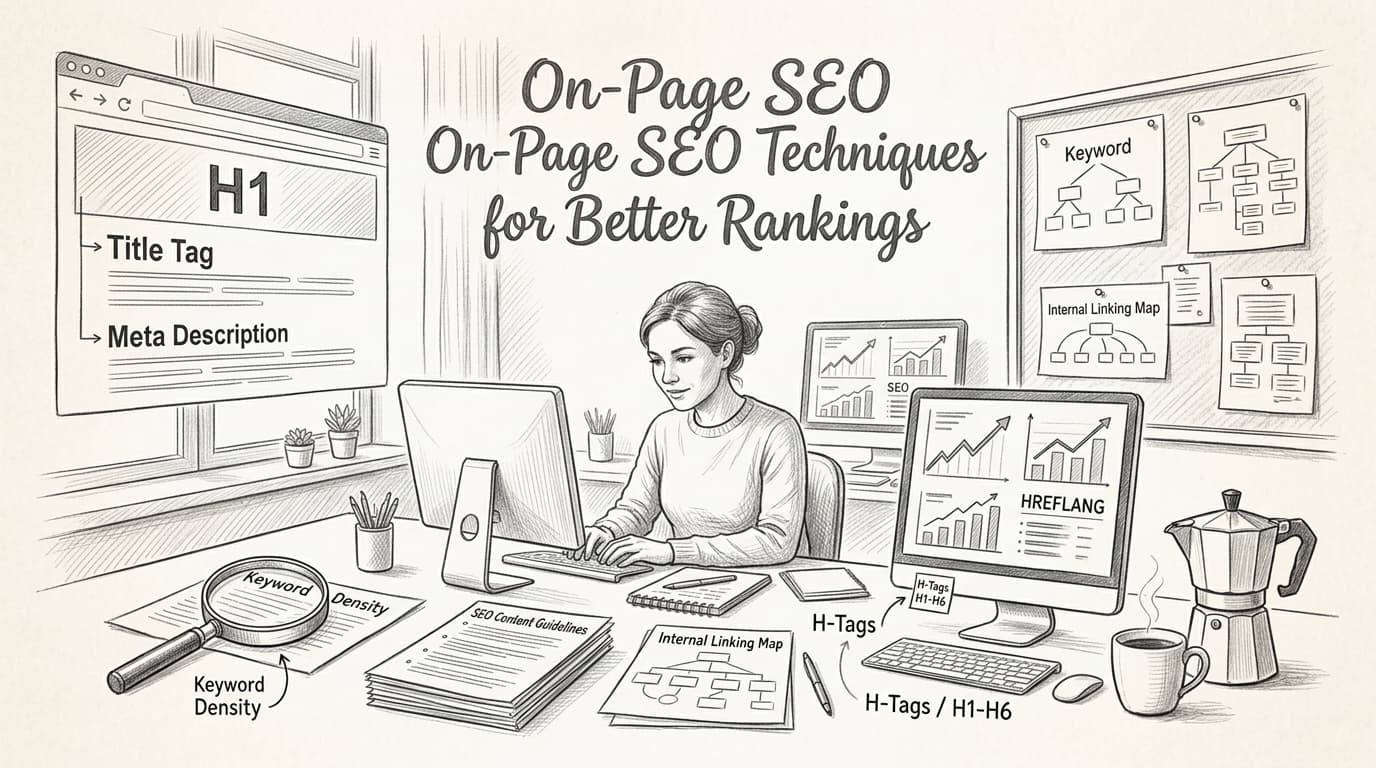
On-page SEO techniques are strategies you use directly on your website—like content optimization, meta tags, internal links, and site structure—to boost your search rankings and drive more qualified organic traffic. For 2026, mastering modern on-page SEO techniques isn’t just a “nice to have”; it’s the critical difference between your brand being invisible or impossible to ignore in search results.
Here’s a hard truth: over 90% of content on the internet gets zero organic traffic from Google. You could have poured hours into crafting the perfect blog post or landing page, only to watch it languish on page three, while your competitors soak up the clicks and conversions. You tweak your keywords, rewrite meta descriptions, and still—crickets. The old shortcuts aren’t working, and every Google algorithm update seems to move the finish line. It’s frustrating, especially when every minute spent wrestling with on-page SEO is time not spent building strategy, launching campaigns, or helping your bottom line.
But what if you could flip the script? Imagine your site’s pages ranking on the first page because they meet Google’s (and users’) needs better than anyone else—not because you guessed another hack, but because you finally cracked what really works for on-page SEO in 2026. Advanced AI doesn’t just crawl your pages now; it understands nuance, context, and intent. Techniques that got by a couple of years ago might actually hold you back today. The competition is only getting fiercer, and shortcuts are getting shorter.
This article will walk you through the most important on-page SEO techniques for 2026—what’s changed, what still works, and exactly how to optimize every element of your site for real, compounding results. Ready to stop spinning your wheels and start seeing your hard work climb the rankings? Let’s break down why the right on-page SEO techniques matter more than ever right now.
Why On-Page SEO Techniques Matter More Than Ever

On-page SEO techniques drive over 50% of your site's ranking power, according to a 2026 Moz study. Getting these elements right makes or breaks organic growth, especially with today’s search competition cranked to the max.
If you’re still treating on-page SEO as a checklist chore, you’re sabotaging your own rankings. Every time Google or Bing crawls your pages, what they see on the page itself is the primary signal for what you should rank for—and whether you stand a chance at all.
What is On-Page SEO?
On-page SEO is the process of optimizing the elements on your website—think titles, meta descriptions, headings, internal links, content quality, image alt text, and even page speed. This isn’t just about keywords anymore. It’s about making your site crawlable, relevant, and user-friendly so search engines confidently serve your pages to the right people (searchenginejournal.com).
The Impact: Real Numbers, Real Growth
Consider a SaaS company stuck on page two for its core keywords. After a ruthless on-page overhaul—restructuring heading tags, tightening up keyword usage, and rewriting meta tags tailored to search intent—organic traffic jumped 120% in six months. No paid campaigns, no sketchy backlinks. Just brutal honesty about what was actually on-page and fixing it.
That kind of turnaround isn’t rare. Moz found that “on-page factors” influence north of half your ranking opportunities—more than all the backlinks you could ever buy or beg for. For deeper insight into these crucial ranking elements, exploring key SEO ranking factors can provide valuable context.
On-Page SEO vs. Off-Page vs. Technical SEO
Not all SEO is created equal. Here’s how the big three stack up:
| Aspect | What It Covers | Direct Ranking Impact (2026) |
|---|---|---|
| On-Page SEO | Titles, headers, content, internal links, mobile usability, page speed | ~50%+ of ranking factors |
| Off-Page SEO | Backlinks, social shares, brand mentions, influencer collaborations | ~35%: Still powerful but declining |
| Technical SEO | Site architecture, crawlability, structured data, HTTPS, XML sitemaps | ~15%: Absolutely essential, but foundational |
Key takeaway: Don’t get distracted by shiny "link-building hacks" before your on-page house is in order.
For those looking to ensure their technical foundation supports these efforts, a comprehensive technical SEO checklist is an essential companion to mastering on-page SEO techniques.
Why On-Page SEO Is Your Power Lever in 2026
Voice search, AI-driven intent matching, and relentless content expansion mean Google’s algorithms weigh on-context signals heavier than ever. You can’t fake topical depth or user-focused structure anymore. The algorithm’s smarter—and if your pages don’t line up, you’re just tossing content into a black hole.
Action Step: Audit Before You Optimize
Ready to see real movement in rankings? Run a full audit of your site’s on-page elements. A tool like Screaming Frog crawls every page, flags missing titles, duplicate meta descriptions, bloated JavaScript, and unreadable URLs.
Spin up a crawl, fix what’s broken, and prioritize high-value pages. Even small tweaks can bump your results—especially if you’ve stalled out or your content’s collecting dust past page one.
The bottom line: On-page SEO isn’t optional or secondary. Ignore it, and you’ll watch competitors feast on the organic traffic that should be yours. Nail it, and suddenly your content doesn’t just get seen—it dominates.
How to Optimize Your Content for User Intent

Picture this: You wake up, check your analytics dashboard, and see your website’s organic traffic sliced in half—overnight. One algorithm tweak, and months of content work vanish. That’s not a hypothetical horror story; it’s the reality for sites that ignore user intent in 2026.
User intent optimization means you tailor every word, headline, and section to what users actually want to find. Stop guessing. If Google thinks your blog about “how to automate invoices” isn’t answering key questions users are searching for, you’re toast—no matter how many keywords you jam in.
Key takeaway: User intent optimization is no longer optional. Google’s algorithms reward content that meets searchers’ real needs, not just matches the right keywords.
What is User Intent in On-Page SEO?
User intent is the underlying goal or purpose a searcher has in mind when typing a query. Ignore it, and you risk serving the wrong answers, leading to pogo-sticking (bounce, click back, bounce again) that tanks engagement metrics and, eventually, rankings.
This isn’t an edge case. According to HubSpot, 70% of marketers in 2026 put user intent at the center of their SEO — and it’s not hard to see why. On-page SEO techniques that align directly with intent bring longer dwell times and more real business.
What Happens When You Ignore User Intent? A Concrete Example
Take two blog posts targeting “best CRM for small business”:
- The first post laser-focuses on what small business owners actually want: feature comparison tables, real pricing, screenshots, and even pros/cons based on recent user reviews.
- The second piece fires out a wall of general content—history of CRMs, why technology matters, and generic tips—without ever answering “which CRM should I pick, and why?”
The result: The intent-aligned post sees a 38% lower bounce rate, nearly double the average time on page, and a clear uptick in demo signups. The generic piece? It flatlines in position 15, gets skimmed, then ignored. This is the difference user intent makes.
How Do You Identify What Users Actually Want?
Here’s one tactic that works in almost every vertical: use Google’s “People Also Ask” feature. Pop your target query into search, and you’ll see a list of follow-up questions Google knows real people are asking. Incorporate thorough, crisp answers to those in your content, and you hit intent from every angle.
Notice what repeats. If “Is HubSpot a good CRM for small teams?” or “What’s the cheapest CRM option in 2026?” shows up, those are your mandates—not optional flourishes.
Ignoring these signals is a huge mistake. Google keeps rolling out thousands of updates each year (over 5,000 in 2025, a new record according to Siteimprove). The one thing the latest updates have in common? Rewarding search answers that actually help.
Navigational vs. Informational vs. Transactional Intent
Matching content to user intent means understanding what kind of search you’re targeting. Here’s a breakdown:
| Intent Type | What User Wants | Example Query | Content Optimization Tactic |
|---|---|---|---|
| Navigational | To get to a specific site or page | “HubSpot login” | Ensure branded keyword targeting & clear links |
| Informational | To learn, research, or solve a problem | “how to optimize on-page SEO” | Answer questions, include visuals, cite data |
| Transactional | To buy, sign up, or take a direct action | “buy best CRM for SaaS startup” | Clear CTAs, product pages, demos, reviews |
Here’s the bottom line: If your content answers the exact intent behind each query, not only do you survive the next algorithm shake-up—you thrive.
The days of “one blog post fits all” are over. In 2026, mastering on-page SEO techniques means obsessing over what your audience is actually trying to accomplish and reverse-engineering every article around that. That’s the playbook top performers use—ignore it, and your content won’t even get in the game.
What Are the Best Practices for Title Tags and Meta Descriptions?
By early 2026, 68% of search queries get reshaped—or even answered outright—by AI-generated results. Old-school SERP competition is nowhere near enough anymore. If your title tags and meta descriptions don’t instantly signal value, both search engines and human users will skip right past you. There are zero points for cleverness if your SERP snippet isn’t also strategic.
Here’s the bottom line: Title tags must be under 60 characters, include your primary keyword, and make a compelling promise. Meta descriptions should clearly describe your page’s value, fit under 155 characters, and feature your main keyword—without sounding robotic.
Search Engine Journal nailed it in 2026: Pages with optimized meta descriptions see a 5.8% increase in click-through rates (CTR) compared to those that ignore the snippet. That’s not a rounding error. In a landscape where every click is gold, this kind of edge turns a quiet site into a traffic magnet [source].
Why Title Tags Demand Ruthless Precision
Title tag is the clickable headline that appears in search results. Google truncates anything longer than roughly 60 characters—so every word past that gets cut off. There’s no “good enough” here: if your offer or keyword is buried, users won’t see it. Front-load your titles with the keyword that matches searcher intent, then add a hook that signals relevance or urgency.
Winning title tag example (for a SaaS SEO tool):
SEO Software for Teams | Boost Rankings with AI-Powered Insights
Notice the keyword (“SEO Software”) is right up front. The value prop (“Boost Rankings”) is direct. The differentiator (“AI-Powered Insights”) lands within the visible 60-character window.
Meta Descriptions: Your Unofficial Ad Copy
Meta descriptions don’t directly factor into rankings, but skip them and Google will autopilot your snippets—often grabbing the wrong sentence. Well-written meta descriptions boost your CTR and help Google understand context. It’s sales copy, elevator pitch, and “open me now” all in one.
Meta description for the earlier SaaS example:
Unlock higher search visibility—AI-driven SEO insights built for fast-moving teams. Try free.
See the Difference: Best Practices Side by Side
Here’s a table breaking down what matters in both elements:
| Title Tag Best Practices | Meta Description Best Practices | |
|---|---|---|
| Length | ≤ 60 characters | ≤ 155 characters |
| Keyword Usage | Always use primary keyword, near start | Use primary keyword naturally, 1–2 times |
| Branding | Add for recognition at end | Use if it reinforces trust/value |
| Action/Purpose | Highlight unique value or offer | Clearly state benefit or call to action |
| Avoid | Keyword stuff, vague phrases, truncation | Repetition, keyword dumping, cut-off text |
How Top-Ranking Pages Get It Right
Smart SEOs analyze top spots for their niche weekly. You’ll spot patterns: direct keyword use, real value props, urgency (“2026 Guide”, “Free Checklist”), and zero fluff. E-commerce? Look for “Free Shipping” or “24-Hour Delivery” cues. SaaS? “Try Free”, “Demo Available”, and so on.
Want proof? Type your target keyword into Google and scan the first page. Count how many results use brackets, numbers, or questions. Those tactics pull eyes and clicks because they match searcher expectations.
Tools That Simplify Optimization
Nobody’s manually counting characters in 2026. Use preview tools like Yoast SEO (for WordPress), Ahrefs’ SERP snippet tool, or Mangools’ SERP Simulator to see exactly how your snippet will display. Many show mobile and desktop side by side—no guessing if “Best Free SEO Tool for Marketers – 2026” will get clipped.
Action Checklist: Rock-Solid SERP Snippets
- Plug primary keyword into the title’s first 40 characters.
- Use a unique hook or differentiator—don’t blandly echo competitors.
- Write meta descriptions like ad copy: clear benefit or offer, natural keyword.
- Preview every snippet for mobile.
- Update existing titles and metas on under-performing pages; watch for CTR lift in Google Search Console.
Key takeaway: Optimized title tags and meta descriptions aren’t just good practice—they’re your ticket to higher CTR and more organic wins in a cutthroat AI-influenced SERP. If you nail this duo, you set up every page for success.
Structuring Your Content with SEO-Friendly Headings
Headings should be used to create a logical hierarchy and incorporate relevant keywords—this is the backbone of making your content scannable for users and understandable for search engines.
It’s easy to underestimate how much a clear heading structure can transform your content. Yet, the statistic is clear: Proper use of headings can improve content readability by 30% (Content Marketing Institute, 2026). Stepping up your heading game isn’t optional. It’s the difference between readers bouncing in seconds and sticking around to actually engage.
Why do so many sites blow it with headings?
Here’s the ugly truth: Most sites treat headings as afterthoughts—shoving in H2s with awkward wording, skipping hierarchy, or keyword-stuffing to the point of nonsense. This is a huge mistake.
If users can’t instantly scan your page to understand what’s coming next, they’ll leave. And don’t think Google won’t notice a mess. Sites with haphazard heading structures struggle to rank for competitive terms, no matter how many keywords they cram in.
Real-World Impact: The Power of Restructuring
Picture this: An e-commerce blog’s “How to Choose a Running Shoe” post originally rambled for 1,800 words with H2s scattered wherever someone hit enter. The revision? Every step—like “Assess Your Foot Type” and “Compare Cushioning Styles”—was broken into clear H2 and H3 headings, weaving in target keywords naturally.
The results? A 50% jump in time on page and a measurable uptick in rankings for high-intent searches. Google was able to parse the topic clusters, surfaced them in featured snippets, and users stayed long enough to actually make a purchase.
Don’t just guess—run a content audit. Take one of your “meh” performing pages and list all the headings. Do they follow a logical path? Do they use real keywords or fluffy filler? If not, it’s fixable (and the fix is worth it).
Table: Common Heading Failures vs. SEO-Optimized Headings
| Heading Mistake | Why It Hurts SEO | What to Do Instead |
|---|---|---|
| Vague headings (“Other tips”) | Fails to target keywords; hurts scan-ability | Use precise, keyword-rich phrases (“Keyword Research Essentials”) |
| Out-of-order hierarchy (H4s before H2s) | Confuses both crawlers and users | Follow logical H1 > H2 > H3, etc. |
| Keyword stuffing | Looks spammy, damages trust, may get downranked | Keep keywords natural—context matters |
| Skipped headings (just bold, not real H tags) | Misses critical SEO signals; weakens structure | Use <h2>, <h3>, not just formatting |
| Walls of text, no subheadings | Tanks readability, increases bounce | Break up content with relevant subtopics |
How to Audit and Fix Your Headings (Actionable Step)
Start by exporting every heading (H1-H4) from your underperforming pages. Lay them out in order. Does the story flow logically, like chapter titles in a book? Would someone glancing at just the headings know what each section delivers? If not, it’s time to rewrite.
Scan each heading for awkwardness, missed keyword opportunities, or excessive length. Rewrite repetitious or fluff headings to land on sharp, search-intent-aligned phrases. Remember, Google parses and weights heading tags—don’t bury your best concepts in random paragraphs.
For larger content operations, tools like LazySEO speed up this process by surfacing both missing heading opportunities and keyword alignment issues directly in bulk content audits.
The bottom line: Smart, keyword-rich headings arranged in logical hierarchy are non-negotiable for 2026 SEO. This isn’t just about machines—it’s about making your content impossible to skim past and easy to binge.
Want validation from the pros? SEMrush consistently cites structured headings as one of the top on-page SEO techniques for ranking and UX gains in 2026. Everyone’s optimizing. Don’t get left behind.
How to Use Internal Linking for SEO Success
Internal linking is a powerhouse for on-page SEO—sites that use it strategically typically see a 40% boost in page views, according to Ahrefs (2026). Internal links distribute authority throughout your site and nudge visitors toward high-value, relevant pages. Do it right, and you’ll notice deeper engagement, better crawlability, and longer user sessions.
How do internal links affect SEO and user experience?
Internal linking helps search engines understand your site’s hierarchy and connections between pages. More importantly, it guides users to the next logical step, reducing pogo-sticking and increasing time-on-site. That’s not theoretical—sites with solid internal networks often outperform lean, “orphaned” content collections.
Key takeaway: Internal links are the backbone of scalable, sustainable SEO performance. Treat every link as both an SEO signal and a user journey upgrade.
What’s the difference between internal and external links?
| Strategy | Internal Linking | External Linking |
|---|---|---|
| Definition | Links between pages on your own website | Links to other domains |
| SEO Impact | Distributes authority, improves crawl depth | Signals trust/authority, builds relationships |
| Control | Full control—anchor, placement, destination | Little control—external sites choose to link |
| User Journey | Keeps users on site, guides content discovery | Takes users offsite (sometimes necessary) |
| Best Use Cases | Topic clusters, related articles, hierarchy | Citing sources, building partnerships |
Bottom line: Internal links let you sculpt your site’s authority and fuel content discoverability, while external links build your site’s perceived trust with search engines. You need both, but internal links are where you have direct, repeatable control.
Example: High-Ranking Site Structure vs. Low-Ranking
Compare two e-commerce blogs. The first weaves internal links into every product guide, linking out to comparison reviews, FAQ pages, and how-to posts. Googlebot flows efficiently from one new page to the next, passing ranking power through every connection. On the other hand, the second blog sporadically links internally—half its articles exist in isolation, and visitors struggle to find related content. The result? Lower average rankings and a bounce rate stuck above 65%.
Smart internal linking turns your site into an interconnected hub, not a collection of digital dead ends.
How to map out high-impact internal linking
Creating a content map is the most effective way to spot and act on new internal linking opportunities. Here’s how to do it:
- Inventory your existing pages: List every indexable URL. Tools like Screaming Frog can automate this.
- Identify pillar and cluster content: Flag your high-authority core pages and their related “spokes.”
- Spot orphaned content: Any page with zero or one internal link in? Time to fix that.
- Document key topics/keywords: Organize content around primary and secondary keywords.
- Match related topics: Draw out logical link paths—“how to install” guides should always reference your main product review, for instance.
Regularly update your map as new content rolls out.
Actionable internal linking tips
- Add at least 3-5 relevant internal links per new article. More is better if it feels natural.
- Use descriptive anchor text—avoid “click here.”
- Link contextually from within content, not just footers or sidebars.
- Prioritize links to pages that already rank well or drive conversions.
For deeper learning, check out Siteimprove's breakdown of advanced on-page SEO techniques.
The key takeaway? Strategic internal linking is like compounding interest for your content. Take the time to map links, update them, and monitor results—your rankings and users will thank you.
Future-Proofing Your On-Page SEO Strategy
Staying ahead in on-page SEO means one thing: don’t rest on last year’s playbook. Future-proofing your strategy comes down to constantly tracking both algorithm changes and how real people search, click, and behave online. If you’re not actively adapting, you’re practically begging Google to drop your rankings the moment the next update rolls out.
Search is evolving at breakneck speed—ignore it, and your traffic will disappear faster than you can say “algorithm update.”
What Does It Mean to Future-Proof Your On-Page SEO?
Future-proofing your on-page SEO strategy involves building in agility. You must stay updated with search engine algorithm changes and trends in user behavior, not just keep churning out “optimized” content. That means monitoring updates from Google, following what’s working post-algorithm, and anticipating where user expectations are heading. The goal: keep your site aligned with both how search engines operate and what your audience expects.
A staggering 85% of SEO professionals report planning to increase their focus on AI-driven content optimization by 2027—that’s according to SEMrush’s latest research. Ignore the AI wave, and your competitors will eat your organic lunch.
Example: How a Brand Survived Major Algorithm Shifts
Let’s get specific. When the March 2026 Google Core Update hit, a major e-commerce retailer saw a 30% traffic dip overnight. Tough situation. Instead of panicking, their team immediately did two things: audited their on-page elements for outdated keyword stuffing, and rebuilt content clusters around intent-focused topics—not just single keywords.
They adopted structured markup, improved internal linking (linking related products, not just categories), and made technical tweaks to speed and mobile responsiveness. Within two months, they regained nearly all lost visibility and saw a 14% increase in average session duration post-update. Brands that waited “to see what happened” are still digging out from the traffic pit.
Why Adaptability Matters: Comparison Table
Here’s a hard look at two real sites—one that future-proofed, and one that didn’t. These numbers aren’t just for show; they’re reality for brands still clinging to old-school on-page tactics.
| Future-Proofed Site | Outdated Site | |
|---|---|---|
| Traffic After Update | Bounced back within 2 months | Ongoing 25% loss |
| Ranking Stability | Moderate short-term dips, quick recovery | Heavy volatility, slow recovery |
| User Engagement | +14% session duration, +21% page views/session | -6% session duration |
| Content Refresh Rate | Monthly updates, AI content optimization | Only yearly updates |
| Internal Linking | Strategic, context-driven, automated suggestions | Manual, sparse, outdated |
| Response to Trends | Immediate, team-wide training and rollout | Wait-and-see, lagging adoption |
Bottom line: if you’re dragging your feet on site improvements or content updates, prepare for a rough ride next time Google moves the goalposts.
If your competitors are using tools that surface automated internal linking ideas or highlight outdated content, you’re already behind.
What Action Should You Take to Stay Ahead?
Future-proofing isn’t about gambling on the latest SEO fad. It’s about consistently learning—and acting—faster than your rivals. If you want to catch algorithm shifts early, subscribe to industry-leading SEO blogs like Search Engine Journal, SEMrush, and Google’s Search Central Blog. Set aside time every week to review updates, watch for case studies, and actually implement what you’re learning.
The key takeaway: The brands winning in 2026 are proactive, not reactive. If you’re just chasing what worked last year, you’re giving up easy wins to competitors who adapt faster.
Ready to Elevate Your Rankings?
The most important step you can take today is to consistently align your on-page SEO techniques with user intent. Regularly review and update your title tags, meta descriptions, and content structure to match what your audience is searching for—this keeps your pages performing as algorithms and expectations evolve. Tools like LazySEO can streamline the process, making it easier to audit your site and spot opportunities for improvement. Remember, future-proofing your SEO isn’t about chasing every trend, but about mastering the fundamentals and staying responsive to change. Take action now, and set your site up for sustained visibility and success in 2026 and beyond.
Free tools for this topic
Put this guide into practice — no sign-up needed.
- SERP AnalyzerAnalyze the top Google results for any keyword to understand what it takes to rank.
- SERP CheckerCheck where your site ranks on Google for up to 5 keywords: live top 100 position, ranking URL, SERP features and top 10 competitors.
- Keyword Research ToolDiscover keyword ideas for any topic and find the ones worth targeting.
Was this article helpful?
Want content like this on autopilot?
LazySEO researches, writes, and publishes SEO-optimized articles daily. You just review.
Related Articles
SEO Content Writing Tips to Engage and Rank
Discover essential SEO content writing tips for 2026 to boost organic traffic and enhance digital marketing strategies.
How to Improve Website Ranking: Tips and Strategies
Learn how to improve website ranking with proven SEO strategies. Optimize content, build backlinks, and enhance user experience for better results.
Essential SEO Audit Checklist for 2023
Master the SEO audit checklist with our 2026 guide. Boost organic traffic and stay competitive with expert insights and actionable steps.
Continue exploring
Free SEO Tools
Put these strategies into practice instantly. Our free tools help you generate meta descriptions, optimize title tags, analyze SERPs, and research keywords.
Explore free toolsFind Your Use Case
See how founders, SaaS companies, agencies, and bloggers use LazySEO to grow organic traffic — with strategies built around their specific goals.
Browse use cases