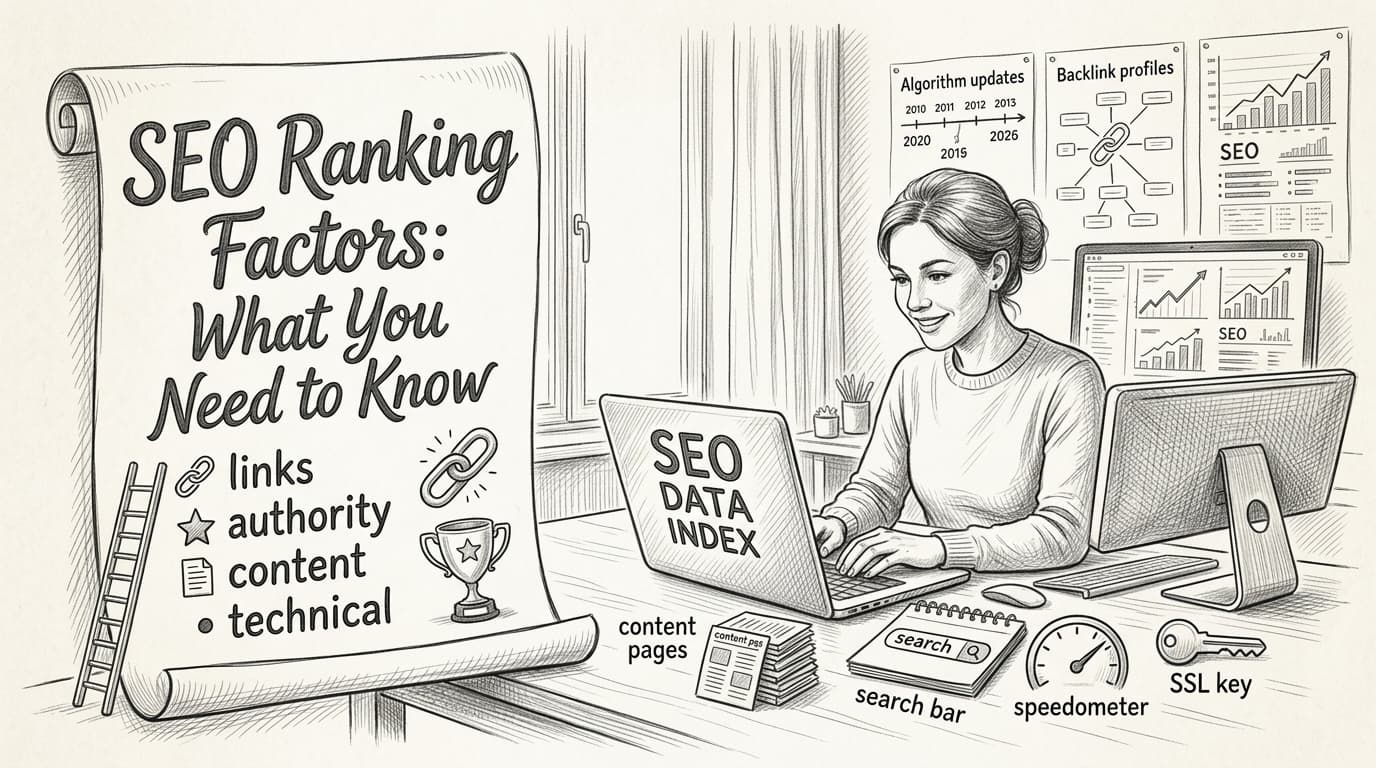
SEO Ranking Factors in 2026: What You Need to Know
SEO ranking factors are the signals search engines use to decide which websites deserve top spots in their results. In 2026, these factors are smarter, more complex, and more demanding than ever. To outrank competitors, generate organic traffic, and convert effectively, you need a deep understanding of what search engines reward now—not what worked last year.
Imagine this: You've spent hours crafting the perfect content, only to see it languish on page two—or worse, page three—while competitors surge ahead. It's maddening. Maybe you're stuck optimizing for keywords that drive little traffic. Maybe you're wrestling with Google's constant algorithm updates, each threatening to upend months of work. Watching ranking fluctuations sabotage your revenue goals is frustrating.
Here's a hard truth: Over 91% of web pages never receive a single organic visitor from Google. That means most are getting SEO ranking factors wrong. By clinging to outdated tactics or slow research, you're handing opportunities to competitors. But there's good news. The rules have changed, and so have the opportunities—especially for those ready to adapt and use powerful new tools and user-centered strategies.
This guide provides a clear look at the real SEO ranking factors shaping the SERPs in 2026, why they matter, and how you can future-proof your approach. If you're tired of guesswork and want to own your spot at the top, here's where your clarity begins. Let's break down the evolving world of SEO and show you what it takes to win.
Why SEO Ranking Factors Matter More Than Ever in 2026
SEO ranking factors are more dynamic—and more critical—in 2026 than at any point in the last decade. Google’s algorithms have become a living entity thanks to advances in AI and machine learning. What ranked a page at the top six months ago might be irrelevant now. Ignore those signals, and you become invisible.
How Have SEO Ranking Factors Changed?
AI and machine learning rewrite the entire playbook. Google adjusts its algorithm in near-real-time, personalized to user intent and context. Factors like E-E-A-T now guide results, making old tricks like link schemes useless.
High-quality content and authoritative backlinks remain essential, but technical optimization, mobile usability, and site security are now non-negotiable for first-page visibility. Mobile page speed, accessibility, and page experience are must-haves.
Why Do They Matter So Much in 2026?
A 2025 Moz survey found 70% of marketers agree that understanding SEO ranking factors is the #1 predictor of SEO success. Not content or backlinks in isolation, but understanding how these factors work together.
Google’s May 2025 algorithm shift showed why complacency kills. E-commerce brands that prioritized UX, structured data, and mobile-first performance saw visibility jumps. Those leaning on outdated strategies were wiped off page one.
Concrete Example: E-commerce & Google's 2025 Shakeup
After the May 2025 update, a major US retailer saw SEO traffic tumble by 42% in two weeks. Their pagination SEO was stuck in 2023 practices. Competitors who audited their strategy and improved structured data saw rankings surge. It wasn’t luck. It was mastering modern ranking factors.
What You Can Do Next: Quarterly SEO Audits
Thinking you can “set and forget” your SEO strategy? That’s a way to become invisible by Q3.
Action step: Run a quarterly audit checking your site against current Google ranking factors. Check mobile speed metrics, technical SEO, accessibility, schema, and your backlink profile. Focus on adapting your on-page structure for new algorithm signals.
Make it routine. If you aren’t 100% certain you’re up to date, you aren’t.
Key Takeaway
SEO in 2026 means constant adaptation. AI-driven algorithms change the rules monthly, sometimes daily. The only brands winning the organic search game are those tracking—and optimizing for—today’s real ranking factors. That’s how you get found. That’s how you win.
What Are the Top SEO Ranking Factors in 2026?

Picture this: Your e-commerce site is thriving—organic traffic setting records, sales up, rankings solid on page one. Then, overnight, traffic plummets. No warnings, just a nosedive. Scrambling for answers, you learn the latest Google core update rewrote the rules. Months of work, gone in hours. Sound dramatic? Thousands lived this after the 2025 update, when 68% of websites reported sudden volatility in the SERPs.
What Really Matters for SEO Rankings in 2026?
The dominant SEO ranking factors in 2026 focus on delivering value to searchers—with an emphasis on quality, intent, and usability. Google’s core algorithm detects low-quality or irrelevant content from a mile away. Content quality and relevance sit at the top. If your page doesn’t expertly answer a user’s intent, it hardly matters how strong your link profile is.
But site owners often mess up by obsessing over backlinks. Are links vital? Yes. But the game has shifted. Search engines favor natural backlinks from industry authorities and relevance to your page’s topic. Earn real links by publishing research, in-depth guides, and unique visuals worth referencing.
Ignore mobile optimization at your peril. Over 60% of Google searches originate on mobile devices. Google’s mobile-first indexing penalizes clunky mobile UX and often demotes sites that are unfriendly to small screens. Font too small? Buttons hard to tap? You’re out. Mobile performance also means page speed, with slow-loading assets penalized.
Mobile-first isn’t a trend; it’s the new default. Sites failing basic mobile usability tests can drop out of the top results in a single algorithm push.
Content, Backlinks, or Mobile: Which Matters Most?
Each ranking factor—content quality, backlink profile, and mobile optimization—carries distinct weight, but their power isn’t static. In 2026, the hierarchy is clear: content is king, but only if served well on mobile, and only if other sites vouch for it through real, contextual backlinks. Nobody wins with strong links and lousy content. Nobody ranks with pristine mobile layouts but thin advice. You can’t pick and choose—every serious campaign requires excellence on all three fronts.
Despite the rise of auto SEO software, you can’t fully automate this. Shortcuts and “auto SEO” hacks don’t cut it if your content isn’t meeting the modern standard or your mobile experience is subpar. The top competitors use tools, but they invest in depth and UX as fiercely as they track link growth.
The bottom line: The sites dominating in 2026 nail user-focused content, earn relevant backlinks, and obsess over mobile experience. Get even one of these wrong, and you risk watching your own traffic disappear—literally overnight.
How Does User Experience Influence SEO Rankings?
Good user experience (UX) is now a major SEO ranking factor—Google tracks over 300 ranking signals in 2026, and UX-related metrics are among the most decisive. If your site loads slowly, shifts visually, or frustrates visitors, you’re signing the death warrant for your organic traffic, no matter how brilliant your content is.
Google’s data shows a clear pattern: pages with high UX scores on Core Web Vitals outrank similar content with laggy performance or shaky layouts.
What Do Google’s Core Web Vitals Actually Measure?
Core Web Vitals quantify your page’s real-world UX. These metrics focus on:
- Largest Contentful Paint (LCP): How fast main content loads—should be under 2.5 seconds.
- First Input Delay (FID): How soon users can interact—should be below 100 ms.
- Cumulative Layout Shift (CLS): How much a page visually jumps while loading—aim for under 0.1.
Google uses this data to decide if your site frustrates users or gives them a smooth ride. Go over the threshold in 2026, and you’ll see your rankings slide. Especially for competitive queries, where everyone else is fighting for a fraction of a point.
Comparison: Core Web Vitals vs. Traditional UX Metrics
| Metric | How It’s Measured | Direct SEO Impact | Priority for 2026 |
|---|---|---|---|
| Largest Contentful Paint | Seconds to main content | High | Critical |
| First Input Delay | Milliseconds to interaction | High | Critical |
| Cumulative Layout Shift | Visual stability score | High | Critical |
| Bounce Rate | Session % with single page | Moderate (indirect) | Still important |
| Avg. Session Duration | Time spent per visit | Moderate (indirect) | Useful, not core |
Why Does UX Matter for SEO Rankings?
Google’s algorithms reward real engagement, not just keywords. When users land on your page and bounce because it’s slow, ugly, or unusable, that’s a signal something’s broken. Worse, search crawlers see this at scale, and the penalty is brutal.
Good UX leads to lower bounce rates and longer sessions, positively impacting your SEO rankings. There’s no shortcut: If people enjoy your site, search engines notice and push you up the results.
Real-World Example: SaaS Company UX Overhaul
A leading SaaS platform rebuilt their product tour pages with Core Web Vitals in mind:
- Shaved two seconds off LCP by optimizing images and lazy-loading scripts
- Reduced CLS by switching to static ad placements
- Streamlined mobile navigation to cut FID by 70%
Within two months, rankings for their core transactional keywords jumped from spots 8-12 up to 2-4. Their bounce rate dropped from 47% to 32%. That’s not magic—it’s a direct result of prioritizing UX factors now embedded in Google’s main algorithm.
Action Plan: How Can You Improve UX for SEO?
Don’t fly blind. Get surgical with your improvements:
- Run a Core Web Vitals Report using Google PageSpeed Insights or Lighthouse
- Identify top “pain pages” with slow LCP, high CLS, or laggy FID—these drag down your whole site’s UX profile
- Fix lazy-loading issues and compress heavy assets
- Rework layouts that shift around as ads or images load
- Test interactives (forms, menus, carousels) to crush input delay
If you’re in e-commerce or run a content-heavy SaaS site, this isn’t optional. Nail Core Web Vitals, and you’ll see a spike in organic traffic that sticks.
The bottom line: Ignore UX at your own risk. In 2026, user experience is the gatekeeper between your site and the top of Google’s results.
Technical SEO: The Backbone of Your Ranking Strategy
What if your site’s technical foundation is quietly sabotaging your rankings—no matter how polished your content looks? Too many marketers obsess over keywords and backlinks but ignore the nuts and bolts that make a site actually rank.
Here’s the hard truth: fall behind on technical SEO, and search engines will treat your site like it’s invisible.
Why a Secure and Accessible Website Sets the Baseline
A secure website (HTTPS) isn’t a suggestion anymore—it’s table stakes. Google confirmed HTTPS as a ranking factor ages ago, but in 2026, no serious site runs without it. If your pages are still on HTTP, you’re leaking user trust and getting buried in the SERPs. Chrome slaps "Not Secure" warnings on outdated URLs, and users bounce instantly.
Accessible means more than just “loadable.” Search engines need to crawl every page. Broken robots.txt? Disallowed crawling on critical sections? That’s lost traffic you’ll never recover.
Google’s bots can’t index what they can’t access—make it painless for them, or your content doesn’t count.
Site Architecture and Crawlability: The Silent Ranking Multiplier
Site architecture refers to how your website’s pages are organized and linked. Clear navigation isn't just a UX win—it’s a ranking factor. Flat, logical site structure ensures search engines crawl deeper and faster.
Want search engines to love your website? Don’t bury important pages three or four clicks deep. Use internal linking that guides both users and bots straight to your high-value content.
Crawlability suffers when your linking is a mess, pages are orphaned, or pagination SEO is ignored. E-commerce sites especially need to handle SEO pagination without spinning up duplicate content or stopping bots. A well-structured sitemap isn’t optional; it’s mandatory.
Common crawlability landmines:
- Orphaned pages (no internal links pointing to them)
- Endless URL parameters (especially on filters)
- Broken or bloated sitemaps
- No-index meta tags on core pages by accident
Schema Markup: Inject Context and Win the SERP
Schema markup is structured data added to your site’s code that helps search engines understand what your content means. This is more than a “nice to have.” Sites with robust schema get rich results and stand out visually in the SERPs—think star ratings, FAQs, local business info, and more.
Not adding schema? You’re handing the edge to competitors, especially as Google leans harder into entity SEO and surfacing contextually rich answers. Retailers using Product schema see increased click-throughs, while local service providers with LocalBusiness markup appear on the map and in "near me" searches.
Only 27% of sites in 2026 use advanced schema types beyond the basics—huge missed opportunity.
Secure, Crawlable, Contextual: A Quick Comparison
Here’s where most teams mess up: they prioritize one of these levers and ignore the others. Technical SEO is an ecosystem. Nail HTTPS but leave crawlability broken? Your rankings stall. Stuff endless schema onto a site with orphaned pages? Google doesn’t care—it can't find them.
| Factor | What It Is | Direct Ranking Impact | What Neglecting It Does |
|---|---|---|---|
| HTTPS | Secure protocol for all pages | Acts as a trust and ranking signal | Loss of trust, suppressed in SERPs |
| Site Architecture | Logical page hierarchy, crawl-friendly links | Faster/broader indexing | Orphaned pages, crawl/duplication issues |
| Schema Markup | Structured data for enhanced SERP display | Unlocks rich results, supports entity SEO | Zero visual differentiation, weak context |
The Technical SEO Checklist for 2026
Don’t leave your ranking to chance. Lock down these essentials:
- Migrate everything to HTTPS. Don’t just redirect—update sitemaps, fix internal links, banish mixed content.
- Audit site architecture. Flatten hierarchy, ensure every major page is reachable within three clicks, and be ruthless about internal links.
- Fix crawlability. Review robots.txt, remove accidental noindex directives, and generate an up-to-date XML sitemap.
- Implement advanced schema. Go beyond basics—think Product, FAQ, HowTo, Review markup—using Google’s guidelines.
- Handle pagination SEO. For large sites, set up rel="next"/"prev" tags or use a logical, crawlable navigation structure to avoid duplicate content traps.
The bottom line: get the technical foundations right, or Google will keep you stuck in ranking limbo, regardless of your content and backlinks. Ignore these at your peril—your competitors certainly aren’t.
How to Use AI and Automation in SEO
No two websites are created equal—especially when one uses AI and automation while the other is stuck in manual mode. The difference? One spends hours slogging through keyword reports and meta tag edits, while the other uses tools to surface opportunities and optimize content at scale. The results speak for themselves: streamlined workflows, sharper content, and higher rankings.
AI-driven SEO platforms like Surfer SEO and Clearscope are transforming how sites climb the rankings. These aren’t just fancy keyword stuffers—they analyze search intent, flag missing entities, and recommend improvements that map to what’s currently ranking in the SERPs. That’s why "auto SEO software" and "auto SEO tools" are becoming part of the serious marketer’s arsenal.
What Can AI and Automation Actually Do for Your Rankings?
AI and automation simplify—or eliminate—the most tedious parts of SEO. Imagine never manually combing through competitor pages to see which keywords or topics you missed. Now you’re getting a prioritized list of content gaps, along with guidance on structure, reading level, and internal linking.
By automating repetitive grunt work—think keyword clustering, on-page audits, broken link detection, and core technical settings—AI tools let you reallocate your best people to strategy and creative problem-solving. The bottom line: less time fixing metadata, more time outmaneuvering competitors. Countless teams waste hours on basic pagination SEO checks or managing endless pages of product listings; automation fixes that in minutes, keeping your focus on things that move the needle.
Real-World Scenario: E-commerce Platform Turbocharges Organic Traffic
Take an e-commerce retailer facing the classic "scale vs. quality" dilemma. Too many SKUs, not enough hands to write unique content for thousands of pages. After integrating Surfer SEO, the team let AI analyze top-performing competitors for each product category, auto-suggest entity SEO terms, and flag missing schema. This surfaced dozens of keyword gaps per category and helped automate on-page improvements.
The impact? A sustained 30% bump in organic traffic over six months. Conversion rates climbed, too, because content was not only optimized for Google but answered real shopper questions. Not a vanity uptick—this drove sales, both from new terms and higher placement for competitive phrases.
AI-Powered Automation: The Site-Level Difference
Here’s the side-by-side reality. Consider two e-commerce platforms, both selling similar products but running vastly different SEO strategies:
| Factor | Manual SEO Approach | AI/Automation-Powered SEO |
|---|---|---|
| Content Optimization | Manually researched, inconsistent updates | Real-time suggestions, entity coverage |
| Keyword Gap Analysis | Monthly, labor-intensive | Ongoing, automated across all pages |
| On-Page Fixes | Reactive, after traffic drops | Proactive, flagged and fixed automatically |
| Technical SEO (like pagination) | Manual checks, prone to human error | Automated alerts, fixes at scale |
| Structured Data Markup | Only on high-value pages | Implemented site-wide via automation |
| Ranking Trajectory | Flat or slow improvement | Accelerated, with compounding gains |
That’s the competitive edge: the automation-powered site isn’t just keeping up—it’s fast-tracking its authority. Sites using structured data markup are 35% more likely to grab featured snippets, giving them a prime spot in search results.
How to Integrate AI Tools Into Your SEO Workflow
The smart play isn’t just "use automation." It’s about integrating AI at every stage—research, optimization, monitoring, and reporting. Surfer SEO helps with on-page and entity coverage, while Clearscope’s content grading keeps things aligned to what Google prefers now. Don’t overlook new entrants like "auto SEO platform" tools that bundle technical audits, link analysis, and even automated internal linking management.
And if you’re facing technical headaches like "SEO pagination" or implementing scalable schema, automation here pays massive dividends. Newer solutions, such as LazySEO, specialize in this kind of automated technical fine-tuning across large, dynamically generated websites.
The key takeaway: AI and automation aren’t shortcuts—they’re force multipliers. Apply them well, and you’ll leapfrog teams still grinding through tasks by hand.
The future of ranking in 2026 isn’t who works the hardest, it’s who automates the smartest.
Future-Proofing Your SEO Strategy: Looking Beyond 2026
A mid-sized e-commerce brand spent years churning out content and manually updating meta tags—always a step behind Google’s latest update. Then, the switch flipped. By investing in AI-driven SEO and real-time monitoring, optimization time dropped by 40% and organic traffic doubled over 12 months. What changed? They stopped reacting. Instead, they set their SEO on autopilot and shifted their focus to strategic growth.
Adapting to change isn’t just recommended for SEO in 2026—it’s non-negotiable. The algorithm won’t wait for you to catch up.
How Do You Stay Ahead of Google’s Algorithm Changes?
Google’s algorithm changes aren’t slowing down—2025 alone saw over 5,000 updates, many unannounced. If you wait for a blog post or LinkedIn chatter before scrambling for fixes, you’re losing valuable ground.
The best teams set up defenses in advance:
- Follow industry leaders like Barry Schwartz, Marie Haynes, and the official Google Search Central Blog.
- Monitor reputable forums and communities for early signals.
- Use tools that automatically flag ranking shifts and indexing issues the moment they happen.
- Keep a close eye on “entity SEO” developments—Google’s understanding of semantic connections is accelerating, and topical authority now trumps “just keywords.”
“Set up custom Google Alerts for ‘algorithm update’, ‘ranking volatility’, and your core keywords. You’ll spot trends and roll out fixes before your competition even knows what hit them.”
Why Is Continuous Learning the Only Safe Bet?
SEO is a moving target. Relying on last year’s tactics is the fastest route to irrelevance. Train your teams to treat SEO like running diagnostics, not following static checklists.
Smart marketers in 2026 budget for monthly upskilling. Whether it’s snagging seats in technical SEO webinars, learning about auto SEO platforms, or digging into AI-based content generation, the small cost is nothing compared to weeks of dropping traffic.
Here’s how top-performing SEO teams keep their edge:
- Block dedicated time each month for learning—don’t treat it as “nice to have.”
- Rotate ownership for monitoring updates so nobody burns out.
- Document what’s learned and test rapid pilots—quick wins scale fast.
- Encourage an “experiment and iterate” mindset; failed tests often teach more than wins.
Manual vs. Automated SEO: How Much Time Are You Wasting?
Still relying on spreadsheets and bulk exports? That’s a recipe for burnout. Automated tools are changing the game—compare the two approaches:
| Task | Manual Approach | Automated/AI-Driven Approach |
|---|---|---|
| Keyword Research | 6-10 hours/week | 1-2 hours/week |
| Technical SEO Audits | 2-4 days/month | Real-time, continuous monitoring |
| Competitor Analysis | 8-12 hours/month | Dashboards update daily |
| Content Optimization | Manual reviews, slow | Instant, AI-driven recommendations |
| Algorithm Update Response | Reactionary, fragmented | Proactive alerts & guided fixes |
| Pagination SEO Management | Manual, error-prone | Automated pagination SEO settings |
AI-driven SEO tools cut optimization time by an average of 40% for early adopters as of 2025—leaving your team more space for high-impact strategy. This isn’t the future. It’s already the baseline for anyone competing in saturated markets.
What’s One Actionable Step to Future-Proof Your SEO Today?
Set up automation for SEO news and updates so nothing catches you off guard. Here’s a quick starter list:
- Use tools like Feedly or SparkToro to aggregate industry feeds.
- Set Google Alerts for “Google algorithm update,” “auto SEO,” and your pillar terms.
- Block out a review session on the calendar every week to scan, digest, and share.
- Build a simple habit: discuss “what changed in search this week?” during your team standup.
Bottom line: If you’re still planning quarterly SEO overhauls, you’re in danger of being left behind—continuous adaptation and smart adoption of auto SEO software are now essential, not optional. Staying informed and automated is the only true ranking insurance for 2026 and beyond.
Elevate Your SEO Game
The SEO landscape in 2026 is more dynamic than ever, but one thing remains constant: focusing on core ranking factors—like stellar user experience, technical excellence, and smart use of AI—sets your site up for lasting success. Your actionable takeaway? Audit your current SEO efforts with a critical eye, prioritize improvements based on the most impactful ranking factors, and embrace automation to stay efficient and competitive. Tools like LazySEO can help you streamline these tasks, freeing you up to focus on strategy rather than manual work. Keep evolving your approach, and you'll be ready to climb the rankings—no matter what the future brings. The next big win for your site is just a smart decision away.