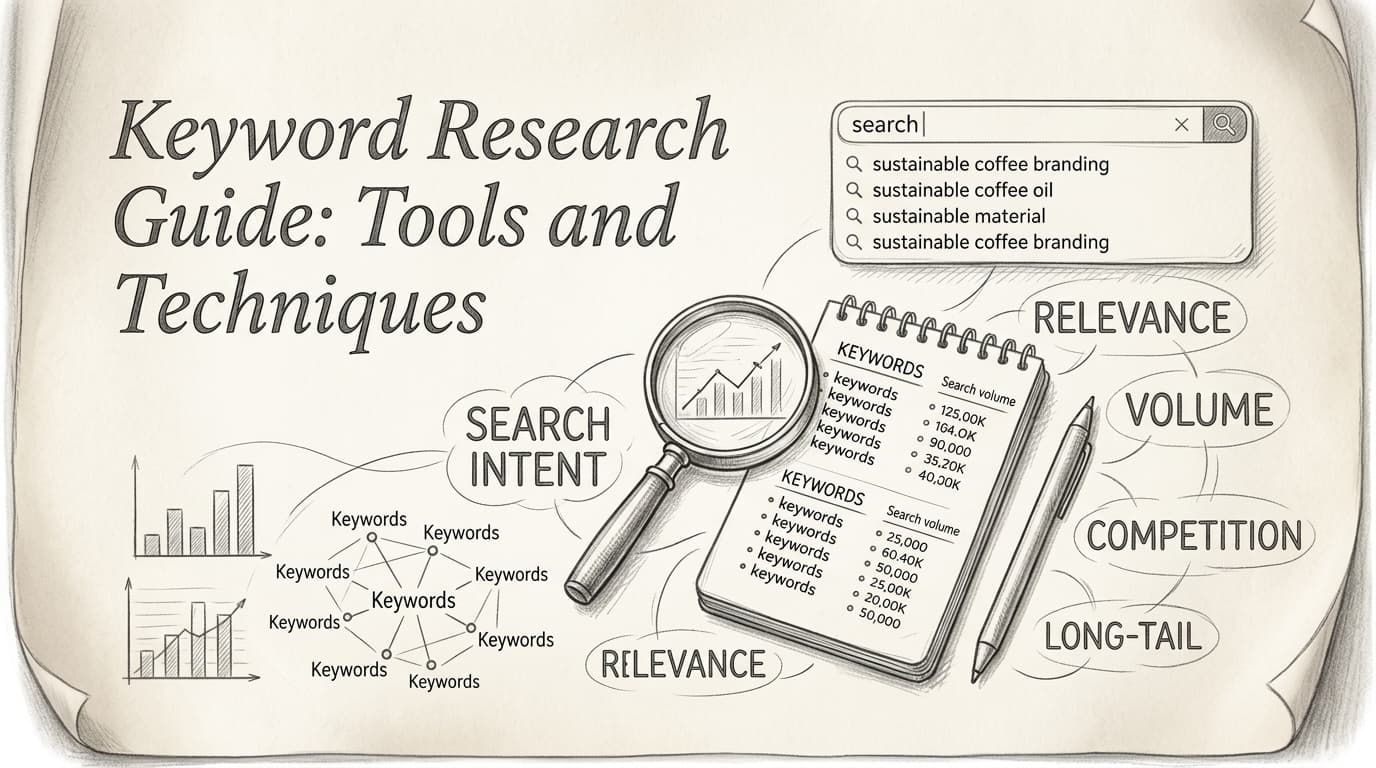
A keyword research guide is your blueprint for discovering, evaluating, and prioritizing the search terms that drive targeted traffic to your site. Mastering keyword research in 2026 means using new AI-powered tools and evolving data sources to find what your audience is actually searching for—then translating those keywords into measurable SEO results. But here’s the reality: even with all the talk about “intent” and “semantic search,” most marketers still struggle to move past generic terms and tap into the phrases that truly convert.
Does this sound familiar? You spend hours combing through keyword tools, only to wind up with endless spreadsheets of high-competition keywords that do little to budge your rankings. You optimize a page, watch analytics, and… nothing happens. The pressure mounts as the cost of paid traffic keeps climbing and your organic growth stalls out. Meanwhile, competitors with seemingly basic content leapfrog in the SERPs and dominate valuable search real estate. It’s frustrating—because you’re not just fighting algorithms, you’re fighting for relevance in a market that rewards agility and precision more than ever.
It’s not your fault. Search has changed. The way people look for answers is evolving faster than most keyword research processes. “Volume” alone is no longer enough—2026’s most successful SEO strategies are built on intent, context, and using machine learning to see opportunities hidden in plain sight. Recent analyses show that brands using advanced keyword clustering and SERP analysis grew organic traffic almost 75% faster last year than those sticking to old-school tactics.
This keyword research guide will unpack what actually works now, not what worked two years ago—helping you reimagine your workflow with smarter tools, sharper targeting, and strategies built for the future of search. Discover how to decode high-value opportunities, map keywords to every stage of your funnel, and use real data for continuous wins—even in verticals crowded with fierce competition. Ready to abandon second-guessing and outdated keyword lists? Let’s start by breaking down why keyword research is absolutely critical for SEO success in 2026.
Why Keyword Research is Crucial for SEO Success in 2026

Keyword research is still the engine that keeps any SEO strategy running in 2026. If you’re wondering why your site isn’t pulling in qualified traffic, it almost always traces back to lazy or outdated keyword work. Skip this step or do it half-heartedly, and you’ll spend the year driving the wrong people to your pages—or worse, no one at all.
Here’s the big shift: search engines now care less about the exact words someone types and way more about what they actually want. That’s user intent—the real reason behind the query. Gone are the days when you could stuff “best project management software” ten times on a landing page and call it a day.
In 2026, search engines read between the lines. They reward content that meets user expectations, not just content that echoes their keywords.
Why Does Keyword Research Matter Right Now?
A solid keyword research process feeds every part of your SEO machine—content creation, technical optimization, and even your site’s architecture. Skipping it is like building a house with no blueprints.
Need proof? According to a 2026 BrightEdge study, 68% of online experiences still start with a search engine. If your site isn’t visible for the queries that matter, you’re invisible. Plain and simple.
And it isn’t just about traffic. It’s about the right traffic—the people ready to buy, subscribe, or take action. Choose the wrong keywords and you’ll attract window shoppers instead of buyers.
Broad Keywords vs. Long-Tail Keywords: Real-World Impact
Let’s break down the difference with a practical scenario.
- Broad keyword: “running shoes”
- Long-tail keyword: “best trail running shoes for flat feet 2026”
If you target “running shoes,” you’re up against major brands with million-dollar ad budgets. Sure, the search volume looks appealing, but you’ll fight an endless uphill battle for rankings. Worse, those clicks? They’re likely generic, and a big chunk might bounce without buying.
Now look at the long-tail: someone typing “best trail running shoes for flat feet 2026” knows exactly what they want. Ranking here means you’re showing up for people ready to buy. These visitors convert at much higher rates—and your SEO effort actually pays off.
Intent is the New Keyword Currency
Search engines evaluate not just what people type, but why they’re typing it. “Keyword navigational intent” is a perfect example. Someone searching for “ahrefs pricing” wants to go straight to the pricing page, not read a generic blog post. If you offer the wrong content, you’ll get ignored—no matter how many times the keyword appears.
Bottom line: Modern keyword research puts user intent front and center. You need to know which queries indicate someone is researching, comparing, or ready to act—then build your content accordingly.
How to Align Your Keyword Strategy for 2026
Here’s an actionable step every SEO should take: Run a keyword audit focused on intent alignment.
- Pull your current keyword targets from Google Search Console, Ahrefs, or SEMrush.
- For each, ask: “Is this really what my ideal customer is searching for? What are they trying to accomplish?”
- Sort keywords by intent: informational, transactional, navigational, or local (Moz has a great framework for this).
- Identify gaps—those high-intent queries you’re missing, or outdated terms where search behavior has shifted.
The world of SEO keeps evolving, but one truth holds: keyword research isn’t dead. It’s just gotten deeper, smarter, and miles more profitable for those who do it right.
How to Identify High-Value Keywords: Tools and Techniques

Losing rankings because you clung to last year’s keywords? A SaaS business watched their traffic nosedive after relying on “best CRM software”—until they realized their competitors were quietly winning with product-focused queries, long-tail modifiers, and intent-matching terms. That's not some freak SEO drama. It’s the reality in 2026: update your keyword approach, or watch your organic reach dry up.
According to a 2025 SEMrush report, 68% of top-ranking pages refreshed their keyword strategies within the previous twelve months. Ignoring this is a gamble with your pipeline.
Here’s the direct answer: High-value keywords are the search terms that directly match what your ideal client is hunting for and actually stand a chance of earning you traffic. They hit that sweet spot—zeroing in on intent, offering respectable search volume, and boasting competition levels you can realistically beat.
What makes a keyword "high value" in 2026?
Forget the old playbook where “high search volume” was all anyone chased. These days, tools like Ahrefs, SEMrush, and Google Keyword Planner zero in on more nuanced indicators: keyword navigational intent, trending modifiers, and rapid shifts in competitive density.
Here’s what you’re actually looking for:
- Intent match: If your SaaS company targets CFOs evaluating software, “best B2B expense tool for CFOs 2026” will outperform “expense management.” Why? It nails intent and appears right when a buyer is deciding.
- Traffic potential, not just search volume: Ahrefs’ “Traffic Potential” metric rewrites the rules here. Example: “AI scheduling tool reviews” may have lower search volume, but more commercial traffic than “calendar app.” (ahrefs.com)
- Low to mid competition: SEMrush lets you filter by “Keyword Difficulty.” In e-commerce, catching the rising wave on a medium-difficulty keyword (“eco-friendly water bottles under $20 2026”) is often more lucrative than swinging at legacy phrases already locked down by mega-brands. (semrush.com)
How do the top keyword research tools actually compare?
Most marketers bounce between Ahrefs, SEMrush, and Google Keyword Planner because they deliver real data at scale—but each serves a slightly different purpose.
- Ahrefs is the research power user’s dream. It digs up exhaustive related terms, exposes your competitors’ top pages, and is ruthlessly up-to-date when new industry terms start trending. Its “Content Gap” tool reveals keywords you’re missing that competitors already rank for.
- SEMrush offers a crystal-clear “Keyword Difficulty” score, competitive SERP analysis, and unique intent labels (like “navigational” or “transactional”). Its recent AI upgrades dissect which SERP features (news, People Also Ask, shopping) dominate for a keyword—so you never chase terms Google won’t reward you for.
- Google Keyword Planner is free and awesomely useful for PPC, but can feel light on true organic insights. Still, nothing beats its direct access to Google’s own ad data, especially if you’re blending paid and organic strategy. But don’t expect real-time SERP movements or in-depth competitor intelligence.
Don’t just window-shop. Plug your core ideas into all three tools. Cross-reference for overlapping opportunities, and surf competitor URLs to see what’s actually ranking—not what only looks good on paper.
Setting up a keyword tracking system—no more guessing games
Too many marketers make the mistake of treating keyword research as a one-and-done thing when it needs to be dynamic and relentless. Set up keyword tracking dashboards using Ahrefs’ “Rank Tracker” or SEMrush’s “Position Tracking.” Monitor how each keyword actually performs after publishing.
Adjust on the fly. If a product review page slips, dig into which new competitors have cracked position 2 or 3—then update your content with fresher examples, related queries, and user-generated questions you see in the SERPs.
The bottom line: High-value keywords are those that align with user search intent, offer real traffic potential, and live in a competitive range you can win—backed by relentless tracking and adaptation using top-tier tools. If you’re stuck picking generic keywords from an outdated list, you’re practically inviting your competitors to outrank you.
Keyword research isn’t just about volume—it’s about strategic relevance, intent, and the agility to pivot as search landscapes evolve.
For a more expanded guide on the technical underpinnings of modern keyword research, check out Moz’s Beginner’s Guide to SEO. If you’re not monitoring keyword navigational intent and competitor gains, you’re already behind.
What Are the Best Practices for Keyword Mapping?
Over 15% of daily Google searches are brand new—never seen before, according to Google's 2024 Search Trends report. With millions of keywords shifting and evolving every month, your keyword research guide means nothing if those terms aren’t laser-targeted to the right pages. That’s where keyword mapping steps in.
Effective keyword mapping assigns specific keywords to individual pages, so each page targets a unique group of search terms—boosting SEO and slashing internal competition. Skip this, and you risk cannibalizing rankings or missing entire intent buckets.
What is Keyword Mapping and Why Does it Matter?
Keyword mapping is the process of assigning target keywords (and their variants) to specific URLs on your website, strategically aligning each page with relevant search intent. When you map keywords directly to content, you ensure:
- No two pages fight for the same term (aka keyword cannibalization)
- Search engines can easily read and rank your pages correctly
- Site structure fits real user intent
Get this right and you let visitors (and Google’s bots) navigate your site with the precision of a GPS.
How to Build an Actionable Keyword Map
Start with your keyword wishlist—those terms you dug up using Ahrefs, SEMrush, Google Keyword Planner, or AI assistants. Then, organize and assign them with ruthless intent. Here’s a quick-hit process:
- List Core Pages: Homepage, service pages, primary blog topics, product categories.
- Assign Primary Keywords: For each page, pick a unique, high-value primary keyword—no overlap allowed.
- Add Secondary & Related Terms: Under each core keyword, list variations and long-tails that capture "keyword navigational intent" and broader semantic relevance.
- Audit for Cannibalization: Scan for duplicate assignments. If two pages fight for the same phrase, consolidate or specialize them.
- Track in a Spreadsheet or Software: Use Google Sheets, Airtable, or specialized SEO tools. A visual map works wonders for spotting gaps and overlaps.
Key takeaway: Every important URL should own a distinct keyword cluster. If multiple pages target the same intent, you’re just splitting your own authority.
Example: How a Site Used Keyword Mapping to Climb the SERPs
Picture an e-commerce brand selling office furniture. Before restructuring, their blog and product pages kept popping up for the same search terms—thanks to old, scattershot keyword “strategy.” Rankings stagnated. Traffic plateaued.
They mapped out all transactional keywords to product and category pages, while informational terms ("how to choose an ergonomic chair") went to targeted blog posts. The result? Six months later, traffic to product pages rose by 39% and blog visits jumped by 21%—all because Google finally understood which page to serve for which query.
Top Tools for Keyword Mapping in 2026
Modern keyword mapping goes way beyond spreadsheets. Here’s how the top tools measure up right now:
| Tool | Best For | Notable Features | Drawbacks |
|---|---|---|---|
| Ahrefs | Enterprise SEOs, Agencies | SERP analysis, automated mapping | Steep learning curve |
| SEMrush | All-rounders | Keyword clusters, intent labels | Higher pricing on pro plans |
| Moz Pro | Beginners, SMBs | Page optimizer, easy visualization | Limited filtering options |
| LazySEO | Automation and speed | AI-based suggestions, mapping UI | Early adoption community |
| Google Sheets | Customization, bootstrappers | Flexible, low-cost | Manual updates, no visuals |
Ahrefs and SEMrush deliver robust, automated clustering. Moz Pro makes the basics dead simple for newcomers. If you want AI guidance plus drag-and-drop mapping, tools like LazySEO make the whole process idiot-proof and scalable.
Action Steps: Start Mapping Smarter—Now
Set aside those generic “keyword planner” routines. Instead, double down on intentional mapping using this playbook:
- Audit your existing pages for overlapping intent. Merge or separate where necessary.
- Build a keyword map: Whether it’s Google Sheets, SEMrush, or LazySEO, consistency trumps bells and whistles.
- Document every assignment—primary, secondary, and supporting keywords—per page.
- Review monthly. As new terms emerge (remember, 15% of Google queries are brand new daily), update your map to catch fresh opportunities.
The bottom line: Keyword mapping isn’t optional—it’s your secret weapon for organized, scalable SEO wins. If you ignore it, you’re driving blind. If you master it, rankings and revenue tend to follow.
For a deep dive into practical workflows, see how Ahrefs approaches keyword research.
How to Analyze Keyword Performance and Adjust Strategies
Regular analysis of keyword performance reveals exactly where your SEO strategy is firing on all cylinders — and where it’s falling short. Without frequent check-ins, you’re gambling your entire content investment on blind hope, not hard data.
Every SEO specialist faces it: “Why isn’t my content ranking despite targeting the right keywords?” Nine times out of ten, the answer isn’t your research. It’s your feedback loop. Even the sharpest keyword strategy falls flat if you’re not measuring real results and tweaking along the way.
What Metrics Reveal the Full Story of Keyword Performance?
It all starts with tracking the right metrics. Google Analytics and Search Console give you the end-to-end view you need — if you know what to look for.
- Click-through rate (CTR) shows which keywords actually get people through the door from the SERPs. A high CTR signals your title and meta description are matching keyword navigational intent. Low CTR? You’re ranking, but your snippet isn’t convincing anyone to click.
- Conversion rate measures whether those visitors do what you want — download, buy, subscribe, or request a demo. Chasing traffic for its own sake is a rookie move. You want keyword traffic that converts into something meaningful for your business.
- Bounce rate tells you if new visitors stick around or head for the exit immediately. High bounce rates on keyword-optimized pages are a red flag: your content isn’t delivering what searchers expect.
Here’s a simple table to keep these metrics straight:
| Metric | What It Shows | Improvement Signal |
|---|---|---|
| Click-Through Rate (CTR) | How enticing your SERP listing is | More clicks vs. impressions |
| Conversion Rate | Visitor actions that create value (sales, signups) | Actions per session |
| Bounce Rate | Whether visitors stick around or nope out fast | Lower is usually better |
How Do You Interpret Performance Shifts?
Think about what changes when you overhaul your keyword targeting. Maybe you swap generic transactional terms for keywords with clearer navigational intent, or double down on long-tails. The only way to know if that was the right call? Compare the “before” and “after” across the core metrics.
Snapshot example: A SaaS blog tweaks its main product page, switching from keyword-stuffed phrases (“best workflow automation 2026”) to intent-focused headers (“how to streamline approvals faster”). Over 60 days, Search Console shows a 45% boost in CTR — but only a small lift in conversions. The lesson? The revamped keywords attract attention, but the content or offer needs further refinement to seal the deal.
Professionals who adopt monthly keyword performance reviews consistently spot ranking plateaus or sudden drops before they turn catastrophic. No one wants to find out three months later that a core keyword lost its spot to a more agile competitor.
What’s the Right Cadence for Keyword Reviews?
Set up monthly reviews — non-negotiable. One-time audits don’t cut it in 2026’s search landscape. Every algorithm update, new competitor launch, or seasonal trend can send results swinging wildly. Use dashboards in Google Analytics and Search Console to automate reporting, so you’re not buried in spreadsheets come review time.
Don’t just eyeball numbers. Drill down: Which keywords moved up? Which lost ground? Is CTR stuck below 2% for high-volume phrases? Are long-tail keywords driving fewer conversions than last quarter? If your bounce rate spikes on a freshly-optimized page, revisit whether the content actually fulfills the promise of the search query.
The bottom line: Regular keyword performance analysis is essential for uncovering what’s working, spotting missed opportunities, and ensuring your entire SEO strategy pivots with real-world changes — not gut feeling. For a deeper dive on choosing and interpreting keyword metrics, check out ahrefs’ keyword research breakdown.
Data-driven SEO doesn’t just boost traffic. It helps you ruthlessly cut what isn’t working, double down on untapped winners, and maintain a pipeline of business-ready search leads all year long.
Navigating Keyword Research for Emerging Technologies
Two websites compete in the same niche. One adapts its keyword research monthly, accounting for changes in technology and search habits. The other sticks to outdated keywords—the ones that performed well years ago. Fast-forward six months: the first site’s organic traffic is climbing, while the second barely keeps pace. This isn’t luck. Brands that review keyword performance monthly see a 22% jump in organic traffic year-over-year, while static strategies get left in the dust (source).
Emerging technologies—think AI, voice assistants, and even search inside AR apps—are rewriting the playbook. If you’re still thinking “desktop SERP,” you’re missing half the picture.
The bottom line: To rank in 2026, your keyword research guide needs to follow how users actually search with new tools—especially voice and AI.
How Do New Technologies Change Keyword Research?
Adapting keyword research for new technologies comes down to understanding user intent. AI-powered search and voice queries don’t just replace keyboard input—they change the language of the query itself.
- Voice search: People talk to Alexa or Google Assistant like they talk to humans. Queries shift from choppy keywords to natural questions—“best running shoes for flat feet under $150,” not “running shoes flat feet.”
- AI-driven search: Tools like Perplexity and ChatGPT Search return direct answers to conversational phrases, not just web pages for clunky keyword strings.
- AR and visual search: Even image searches are getting smarter. Users snap a photo and ask for “products like this”—which means optimizing for semantic search terms and related queries, not just brand names.
This is where most outdated SEO strategies fall short. A static keyword list built for desktop just doesn’t translate.
Side-by-Side: Who Wins with Adaptation?
Here’s how two competing ecommerce brands stack up. One reviews keywords for emerging tech each month; the other does not.
| Metric | Brand Adapting for New Tech | Brand Using Legacy SEO |
|---|---|---|
| Year-over-year organic traffic | +22% | +4% |
| Voice search impression share | 51% | 13% |
| Featured snippet wins | 18 per month | 3 per month |
| AI-driven query visibility | 38% | 6% |
The difference is night and day. You don’t just get more traffic—you show up wherever those cutting-edge users are searching.
What Does a Voice-Optimized Keyword Strategy Actually Look Like?
Picture a home services brand pivoting in 2026. The marketing team reads the data: “keyword navigational intent” is trending upward, voice queries are getting longer and more conversational, and smart home device usage is skyrocketing.
Instead of just “HVAC repair,” they start targeting:
- “Who fixes leaking AC fast in Dallas?”
- “Local certified HVAC installers near me”
- “How long does it take to fix a broken heater?”
They rewrite blog headers as questions. They add FAQ pages with natural-language answers. Result: Their voice search impressions double, and they start claiming position zero in the new AI-rich answer boxes.
Action Steps to Stay Ahead
If your strategy doesn’t account for emerging technologies, you’re handing traffic to your competitors. Here’s what works in 2026:
- Analyze your current queries with Google Search Console and look for long-tail, question-based, and voice search patterns.
- Update keyword lists monthly—not yearly. Spy on competitors using modern tools (SEMrush, Ahrefs) and look for “People Also Ask” trends.
- Test content around spoken phrases. Write FAQ sections and conversational titles: “How do I…” “Where can you…”—these rank for voice and AI.
- Optimize for featured snippets by answering targeted questions succinctly.
- Monitor AI-driven search behaviors (what’s ranking on Perplexity, ChatGPT, Gemini?) and adapt content for those formats.
Keep experimenting. Treat keyword research like a living system—what works for voice search today might need fine-tuning for an AI search engine tomorrow.
Key takeaway: In 2026, the best keyword research guide isn’t static—it evolves with technology and how users search. If your strategy adapts quickly, you’ll capture traffic others don’t even see.
Future-Proofing Your Keyword Strategy: Trends to Watch
Picture this: a mid-sized e-commerce retailer saw its organic traffic spike by 30% in a single quarter—not by gambling on another generic SEO “hack,” but by overhauling its keyword strategy for voice search. While competitors chased legacy keywords, this brand focused on conversational phrases and long-tail queries, optimized for how people speak instead of how they type. The result? Their products surfaced directly in voice assistant answers—far ahead of the pack.
That’s the future you’re preparing for. Future-proofing your keyword research guide means continually learning and adapting your keyword strategy to match evolving search engines and user expectations. Resting on what worked last year is the fastest way to lose ground.
What’s Changing in Keyword Research?
Search algorithms and user behavior aren’t static. Google, Bing, and the newer AI-driven engines update frequently—sometimes dozens of times per year. What ranked yesterday may drop tomorrow, especially as user search habits rapidly shift.
Let’s talk specifics: voice search queries are expected to account for 40% of all searches by 2026 (Comscore, 2025). Instead of typing “best pizza in Brooklyn,” your audience asks, “What’s the best pizza place open now near me?” If your keyword strategy feels stuck in a desktop-centric world, you’re writing for the past.
And it’s not just about voice. Visual search, AR search overlays, new social channels, and even AI-assisted search chat are rising fast. Keywords aren’t just about screens anymore—they’re woven into every customer touchpoint.
Example: How Trends Shift Strategies
Look at what happened when Google started prioritizing intent-based search, especially keyword navigational intent. Companies that clung to old-school, broad-match keywords saw click-throughs fall off a cliff. The winners studied what their audience was trying to do—not just what they typed—and pivoted to target those queries.
Now, factor in platforms like TikTok and Instagram, where hashtags matter as much as Google keywords. In retail, for instance, savvy brands map keywords across Google, Pinterest, and social to catch shoppers bouncing between search and social feeds. Channels are fragmenting; your strategy can’t live in a silo.
How Do You Actually Stay Ahead?
Continuous learning is non-negotiable. Here’s a practical approach to keeping your keyword strategy relevant through 2026 and beyond:
- Watch algorithm updates: Sign up for search engine blog alerts (think Google Search Central Blog, Moz, Search Engine Journal). These sources break down how updates impact rankings, sometimes before most SEOs notice the fallout.
- Study user behavior shifts: Use tools like Google Trends and SEMrush’s Topic Research to spot changes in how people search as new devices and platforms arrive on the scene.
- Join industry communities: Active forums (like Moz Community) and Slack groups let you crowdsource the latest strategies—the stuff you won’t find in an official Google announcement.
- Subscribe to SEO newsletters: The best ones (SEOFOMO, #SEMRush Newsletter) deliver trend breakdowns, case studies, and actionable ideas weekly. Miss an emerging trend, and you could lose months of competitive advantage.
- Experiment and measure: Don’t just read about new tactics—A/B test them in your own campaigns and monitor with Google Search Console or an equivalent. Not everything will work, but you’ll spot winners before they go mainstream.
Key takeaway: Future-proofing your keyword research guide means staying curious, experimenting early, and building habits for continuous monitoring—not locking in a playbook and hoping for the best.
What Should You Prioritize Next?
Now’s the time to audit your strategy for which trends you’re preparing for—and which ones you’re ignoring at your peril:
- Are you optimizing for voice and conversational search yet?
- Do you understand how keyword navigational intent shapes your audience’s journey?
- Are you actively mapping keywords to new search platforms, from AR-enabled apps to TikTok Discover?
If not, those windows won’t stay open forever. Adapt, experiment, and most importantly, stay connected to where search is actually happening—not just where it used to be. The future of keyword research isn’t a static checklist. It’s a moving target, and the agile win.
Bottom line: the only guarantee in keyword research is change—your habits must evolve faster than the algorithms.
Ready to Level Up Your SEO Game?
To truly master SEO in 2026, make keyword research a continuous habit—not a one-time task. Prioritize high-value keywords, map them strategically, and regularly analyze your results to stay ahead of shifting trends and technologies. The most actionable move you can make right now? Block time each month to review your keyword data and adjust your strategy based on what’s actually driving results. Tools like LazySEO can streamline this process, helping you identify fresh opportunities and automate the heavy lifting. Stay proactive, keep experimenting, and watch your search visibility grow—because the future belongs to those ready to adapt and optimize.
For a thorough keyword research guide covering essential tools and techniques, be sure to explore expert insights that complement this strategy. Additionally, beginners may find our detailed keyword research tutorial invaluable for building foundational skills. Finally, for ongoing SEO strategy development that integrates keyword research effectively, consider our comprehensive SEO strategy planning resource.