
- SEO Strategy
- Website Ranking
- Content Creation
How to Improve Website Ranking with Technical SEO

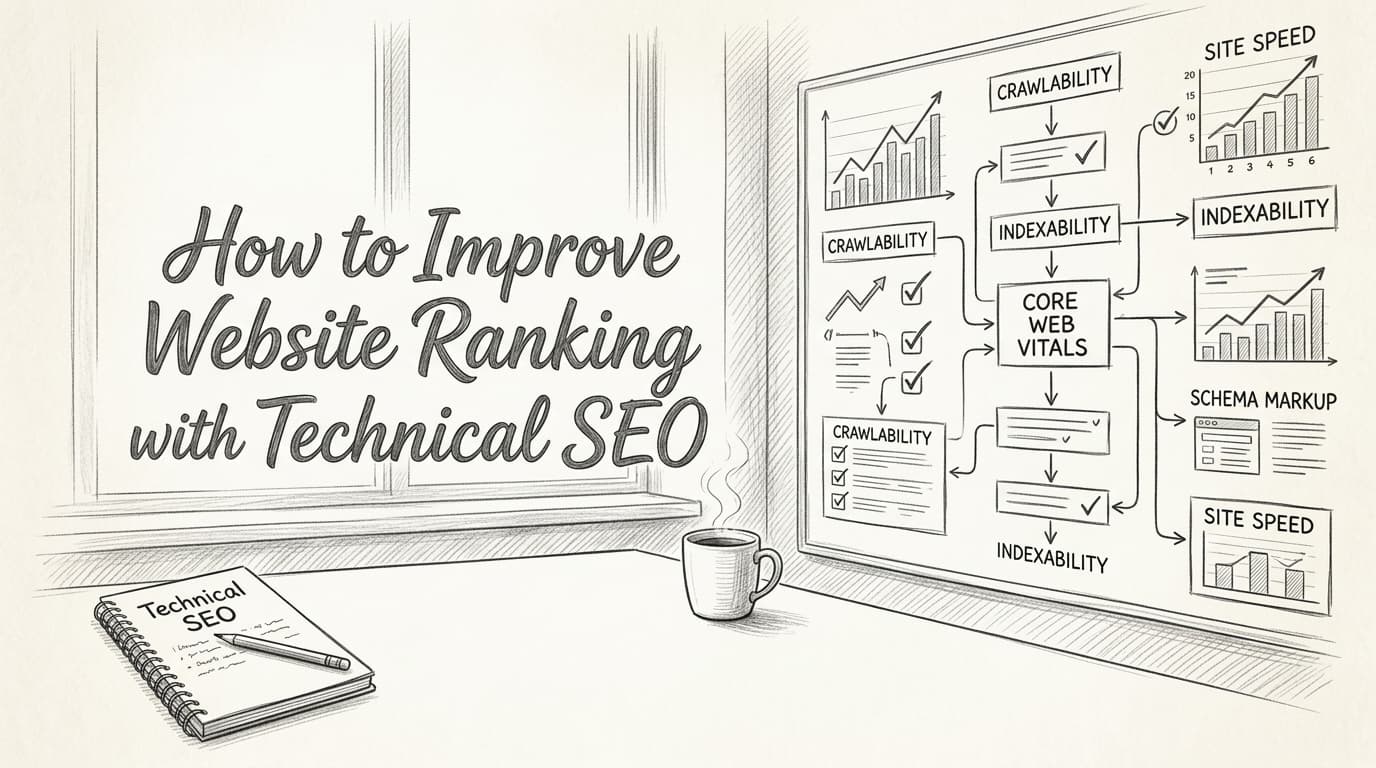
If you want to know how to improve website ranking, you need to master a blend of technical expertise, on-page precision, and content strategy—because simply publishing content or buying a handful of backlinks isn’t enough in 2026. The websites reaching page one today are optimizing every aspect of their presence, from site speed to search intent, and using the latest SEO tactics to outpace the competition. If organic traffic feels stubbornly out of reach—or your team is buried in endless keyword research spreadsheets with little to show for it—you’re not alone.
Here’s a reality check: over 90% of all web pages get zero organic traffic from Google. Picture that. All the hours poured into brainstorming blog topics, the careful crafting of landing page copy, the never-ending cycle of technical audits—yet your analytics still flatline. You tweak a meta tag here, inject a long-tail keyword there, and pray for a miracle. Meanwhile, your competitors seem to effortlessly climb the ranks, capturing leads and revenue that could just as easily be yours.
You don’t need another vague “just create quality content” tip. You need a blueprint that actually works, even as search algorithms get smarter and ranking factors evolve overnight. This guide isn’t just about keeping up with the changes; it’s about getting ahead—combining proven on-page techniques, modern link-building strategies, and a technical foundation that silences both Googlebot and human visitors’ complaints.
By the time you reach the end of this article, you’ll know exactly which SEO tactics drive rankings now, what’s propelling your competitors forward, and how to prioritize your time for real, measurable results. Ready to move your website from buried to visible? Let’s dive in by understanding why your website ranking matters more than ever.
Why Your Website Ranking Matters More Than Ever

Getting your site to rank on the first page isn’t just an ego boost—it’s a bottom-line issue. In 2026, over 90% of online experiences kick off with a search engine. If your business isn’t visible right at the top, you’re invisible to the vast majority of potential customers.
Here’s the hard truth: The first organic result on Google still dominates, pulling in about 28.5% of all clicks. Make it to the top position, and you’ll see a surge in qualified traffic. Land on page two? You might as well be invisible. Don’t believe it? A recent study on search engine rankings confirms that click-through rates drop off a cliff once users scroll past the initial set of results.
The Compounding Impact of High Rankings
Ranking is more than just a vanity metric—it directly impacts sales, brand authority, and acquisition costs. Take this scenario: An e-commerce store managed to move from the second page to the first page of Google results for its highest-converting keyword. The outcome? A 35% jump in sales over the following quarter. That’s not an edge case; that’s the norm for businesses that treat SEO as a revenue channel, not just a marketing checkbox.
Don’t just look at the top-level traffic increase. Higher rankings bring in more of the right traffic—people who are ready to buy, not just browsing. If you’re stuck on the second page, you’re collecting digital tumbleweeds while your competitors feast.
Why 2026 Is a Whole New Ballgame
Organic search habits are evolving. The days when you could throw out a few keyword-stuffed blog posts and call it a day are over. Modern users rely on search engines as their only discovery tool. And with generative AI in search and featured snippets becoming “zero-click” answers, competition for those top spots is at an all-time high.
What’s changed? Google’s algorithms have gotten even better at surfacing authoritative, relevant content—and punishing outdated, thin, or duplicate pages. Sites that fail to meet user intent or ignore search UX requirements get pushed further down the stack.
Fast Wins: Audit Your Current Rankings
Before you worry about the specifics of how to improve website ranking, get a reality check. Here's how to quickly size up where you stand:
- Google your brand and core keywords. Where do you show up? Are you above the fold or buried?
- Check for duplicate or thin content using tools like Site:yourdomain.com searches.
- Review your backlink portfolio. If you’re still asking, “how to manage your backlinks” or “how to create backlinks to your site,” you’re behind—backlink authority is table stakes now.
- Look for outdated pages. If you haven’t touched a page in over a year, it’s probably dragging everything down.
The bottom line: High website rankings drive real business growth, but the competition is fierce and user expectations are changing fast. If you aren’t actively auditing and optimizing, you’re gifting customers to your savvier rivals.
Modern sites that nail ranking optimization get the lion’s share of traffic, sales, and brand recognition. Ignore it, and you’ll be left fighting for scraps while new competitors outrank you seemingly overnight.
What Are the Best On-Page SEO Practices?

Here’s the difference between domination and digital invisibility in 2026: One SaaS company is fielding demo requests nonstop, while their nearest competitor’s inbox sits empty. The difference? That coveted top three spot on the Google results page. According to SearchMetrics, 68% of all website traffic in competitive industries goes to the top three organic results. If you’re not up there, you’re basically waving from the back row at the concert—no one’s paying attention.
So, how do you actually improve website ranking and elbow your way to the front? On-page SEO is where you put in the real work.
On-page SEO means optimizing every element on your website—from what’s visible to users (like headings and images) to what search engines see behind the scenes (like title tags and schema). Nail this, and you boost both search ranking and clicks.
Start with the title tag. This is the clickable blue link in search results, and it’s absolutely non-negotiable for SEO. Stuff it with keywords and you’re toast—Google’s 2026 algorithms are onto that game. Go too vague and you’re invisible. The sweet spot? One primary keyword, your brand if it fits, and a punchy hook that invites clicks.
Right below sits the overlooked workhorse: the meta description. Sleeper MVP. While it won’t directly vault you to page one, it’s the copy that makes a searcher say, “This is exactly what I need.” In 2026, Google’s language models are smart enough to rewrite lackluster or duplicate meta descriptions. If you’re lazy here, expect AI to take over—and it’s rarely as sharp as a hand-tailored pitch.
Headers matter just as much. Header tags (H1, H2, H3) break up your content for both readers and search engines. The H1 is your billboard; H2s and H3s are the organized aisles that help Google crawl your page. Mess up the hierarchy or stuff them with keywords, and your site looks like spam from 2021.
Here’s what the impact really looks like: A B2B SaaS platform spending a weekend reworking its meta descriptions and tightening up H1-H3 structure saw a 50% spike in organic traffic within two months. Same site. Same product. Just sharper on-page execution.
You can’t ignore URL structure, either. Descriptive, human-readable URLs—like /pricing instead of /page?id=67—win both for crawlers and humans. Keep them short and relevant, and you’ve already outdone half your competition.
Bloated, slow-loading pages? That’s another silent ranking killer. Compress images, run Google’s PageSpeed Insights, and remember: nothing sends users (and rankings) south faster than sluggish performance.
Don’t just “set and forget” on-page elements. Search engines recalibrate constantly, so even something as basic as refreshing an old meta description or swapping in a powerful new H2 can move you up the ladder. Regularly use auditing tools like Yoast SEO to surface duplicate tags, missing alt text, and weak headers. If you’re skimping here, your rivals will eat your lunch.
The big mistake? Treating on-page SEO like a checklist instead of a battleground for every click and lead. In ultra-competitive niches, details decide who lands the lion’s share of that 68%.
Key takeaway: Optimizing title tags, meta descriptions, headers, and site structure is the fastest, most controllable way to climb into those top three results—and claim the majority of your market’s organic traffic. The brands thriving in 2026 don’t leave these basics to chance. For a detailed approach, reviewing a technical SEO checklist can help ensure you cover all foundational elements.
How to Build and Manage Backlinks Effectively
Backlinks are links from other websites to your own. They’re the currency of SEO: the more high-quality links your site earns, the greater your authority—and the better your rankings. According to a 2026 SEMrush study, websites with a solid backlink profile rank 40% higher than those without that authority (source).
Here’s the bottom line: If you’re ignoring backlinks, you’re leaving rankings—and revenue—on the table.
Backlinks signal to search engines that your site is trusted by others. No amount of on-page SEO will compensate for a non-existent link profile.
How do you create backlinks to your site?
Building backlinks is about earning editorial mentions, not gaming the system with spammy tactics. Here’s what actually drives results in 2026:
- Guest Blogging on Industry Sites: Still king, when done for real thought leadership—not generic link drops.
- Original Research or Data Studies: People link to what they reference. Publish a unique stat or survey, and earn passive links.
- Broken Link Outreach: Find outdated links on relevant sites, then suggest your better, updated resource.
- Partner/Webinar Pages: Collaborate with partners for events or joint content; ask for a link from their “resources” or “events” page.
Trying to figure out how to build backlinks fast? Shortcuts (buying links, private blog networks) invite Google penalties. Quality always beats quantity—one editorial link from a respected site outperforms dozens of junk links.
Manual vs. Automated vs. Outsourced Backlink Building
Not all backlink strategies are created equal. Here’s how the main approaches stack up today:
| Method | Pros | Cons | Best For |
|---|---|---|---|
| Manual | Complete control; highest relevance | Time-consuming, requires real relationships | Niche/authority-building, long-term |
| Automated Tools | Scalable, great for tracking & outreach | Risk of low-quality/spammy links if abused | Monitoring, scaled outreach |
| Outsourcing (Agencies) | Useful for scale and expertise | Variable quality, higher cost, less control | Fast growth, resource-constrained |
Manual link building is best for those asking "how to build backlinks manually" or want absolute ownership over outreach and relationships. Automated tools—think BuzzStream, SEMrush Link Building Tool—are ideal for discovering opportunities or managing outreach at scale, not for generating authentic editorial links on autopilot.
How to manage your backlinks (and avoid losing ground)
Accumulating links is just the start. Backlink management means:
- Regularly monitoring your link profile for toxic or spammy links (use Ahrefs, SEMrush, or Google Search Console).
- Disavowing harmful links that could drag down your authority.
- Reclaiming lost links (reach out when a good link disappears due to site changes).
- Tracking new mentions and celebrating every win.
Neglecting link hygiene? You’re risking a Google penalty and tanking your hard-won progress.
Real-World Example: The 60% Lift from Smart Guest Blogging
Here’s what’s actually working: A digital marketing agency landed a SaaS client stuck on page 2 for competitive keywords. By targeting 10 guest posts on respected industry blogs (not generic directories), the client’s backlink profile soared—and within four months, organic traffic jumped 60%. Rankings for three profitable keywords hit the top five, translating directly into trial signups and pipeline.
Key Takeaway
Backlinks are the most reliable SEO growth lever—when earned authentically and managed ruthlessly. A strong, well-curated link profile will outpace competitors clinging to outdated, easy-win tactics. If you haven’t revisited your link strategy and monitoring process yet, you’re overdue for a tune-up. For a comprehensive walkthrough on link building, see our step-by-step guide to building backlinks.
Content is King: Creating SEO-Friendly Content
Investing in backlinks and still not seeing your rankings budge? You’re not alone. This issue plagues seasoned SEOs and digital marketers alike: pouring hours into outreach and link swaps, only for Google to shrug. Here’s the kicker most miss—backlinks can’t compensate for thin, irrelevant, or outdated content. When your actual site pages aren’t pulling their weight, no link-building “hack” can rescue your rankings.
SEO-friendly content isn’t just keyword-stuffed text. It’s content crafted for both users and search engines, focusing relentlessly on relevance, depth, and usefulness. The bottom line? Google’s algorithms are obsessed with serving the most valuable answers—to real humans.
The key takeaway: No amount of backlink building will outrank a competitor consistently publishing stronger, more useful content.
What Does SEO-Friendly Content Actually Mean in 2026?
SEO-friendly content means covering topics in a way that leaves no questions unanswered for your reader, while weaving in search terms naturally and using formatting that makes Google’s job easier.
You want:
- Content that answers user intent, fast.
- Headers, structure, and metadata that help Google “understand” your expertise.
- Regular updates, so information is never stale (and you impress both users and bots).
Being “SEO-friendly” also means being “conversion-friendly.” High-ranking content keeps users engaged, which slashes bounce rates and cranks up time-on-site—two signals Google tracks closely.
Why Content Frequency and Quality Can’t Be Ignored
Here’s what separates sites that rank from sites that just get crawled: consistent publishing. According to MTU’s web team, websites regularly updating their content see a 126% increase in the number of indexed pages. More indexed pages mean more chances to rank—not rocket science, but ignored by far too many marketers.
Consider the SaaS company that went from sub-1,000 monthly visits to 25,000. The magic? Building a content calendar and sticking to a weekly publish schedule. Every new post injected fresh, target-rich content into the site, exponentially increasing long-tail opportunities. After three months, their top-funnel blog traffic had literally doubled, no expensive backlink blitz required.
Table: What Separates “Thin” Content from Rank-Worthy Content?
Here’s a side-by-side snapshot—no jargon, just facts:
| Feature | Thin / Outdated Content | SEO-Friendly, Rank-Worthy Content |
|---|---|---|
| Depth of Information | Surface-level, generic | Detailed, actionable, insightful |
| Keyword Integration | Awkward, stuffed, repetitive | Natural, semantically diverse |
| Updatedness | Rarely or never refreshed | Routinely updated, always current |
| Internal Linking | Lacking, random | Intentional, contextually relevant |
| User Engagement | Short sessions, high bounce | Long sessions, low bounce |
| Visuals/Media | Mostly text, few images | Rich media: charts, videos, images |
| Conversion Hooks | Weak or missing CTAs | Strategic, aligned CTAs |
If you can look at your last five blog posts and see more columns from the left, Houston, you have a problem.
How to Build a Real Content Strategy (Not Just More Noise)
Stop guessing what to write. Start with keyword research that digs into what your audience actually wants to know. Cluster those search terms into topics, then map out a schedule so your content library grows with logical depth—not random, disconnected posts.
Regular updates are the underrated secret weapon. Republishing evergreen guides with new stats, screenshots, or examples keeps the page competitive, signaling freshness to Google.
And for those ready to get organized, tools like LazySEO can help turn an ad-hoc slog into a streamlined, strategic publishing machine.
Google’s own documentation repeatedly emphasizes this approach: “Publishing relevant, authoritative content and updating it regularly leads to higher rankings and more traffic” (developers.google.com SEO Starter Guide). Ignore this, and you’ll watch better-optimized competitors leapfrog you—no matter how many backlinks you buy or beg for.
The short version: If your content’s not written for humans and structured for search, you’re already behind the curve. Fix your foundation before worrying about the next shiny ranking trick.
Technical SEO: The Backbone of Your Website's Performance
Fast, accessible websites are table stakes for SEO in 2026. Just look at the case of a retail site that cut its load time by two seconds—not only did shoppers stick around longer, but search traffic jumped a whopping 30%. No fancy backlink scheme, no massive content sprint—just a smarter, faster site. That’s the silent power of technical SEO.
Technical SEO means optimizing the infrastructure of your website to maximize crawlability, indexability, and site performance. If you want to rank, you can’t afford to skip it. Every SEO specialist has dealt with a “ghosted” site stuck on page three—often, sluggish load times or crawl errors are the culprit.
Websites with fast loading times have a 70% higher chance of ranking on Google’s first page. Site speed isn’t just user experience; it’s a pure search advantage [source].
What is Technical SEO?
Technical SEO is the practice of optimizing your site’s underlying code and architecture to help search engines crawl and index it efficiently, while also improving user experience. If Google’s bots can’t find or understand your pages, great content and robust backlinks won’t save you.
Here’s what high-performing sites always nail:
- Mobile optimization: Your site needs to look and run flawlessly on every device. Google’s mobile-first indexing rolled out years ago, yet far too many sites still stumble here.
- Site speed/compression: Reduce image sizes, leverage browser caching, and kill unnecessary scripts. Every extra second of load time bleeds rankings and conversions.
- SSL (Secure Sockets Layer): An HTTPS site isn’t optional. Secure connections are a ranking factor and critical for user trust.
- Clean, crawlable architecture: Logical internal links, sitemaps, and clear navigation help both users and bots. Don’t bury important pages three clicks deep.
- No technical dead ends: Eliminate 404 errors, chains of redirects, and duplicate content. Search engines hate wasting resources on broken links or duplicate URLs.
Mobile Optimization, Site Speed, and SSL: What Matters Most?
If there’s a “big three” of technical SEO, it’s mobile optimization, site speed, and SSL. Here’s how they compare:
| Aspect | Why It Matters | Impact on SEO | Easy Wins |
|---|---|---|---|
| Mobile Optimization | Google indexes mobile version first | Poor mobile = lost rankings | Responsive design, mobile-friendly menus |
| Site Speed | Correlates directly with rankings & UX | Slow = higher bounce rate | Compress images, defer JS, fast hosting |
| SSL | Google prefers HTTPS | Non-HTTPS = flagged sites | Install free certificates, force HTTPS |
Want proof these elements move the needle? Retailers and publishers that started loading two seconds faster saw not just better search visibility, but also a measurable 8-12% boost in mobile conversions. That’s money on the table.
How to Audit Your Site’s Technical SEO (Without a CS Degree)
Confused where to start? Here’s a simple checklist:
- Run Lighthouse (or PageSpeed Insights): Identify slow assets, heavy scripts, and lazy-loading opportunities.
- Check for HTTPS everywhere: Redirect any HTTP URLs to HTTPS and install a valid SSL certificate.
- Test on multiple devices: Use browser emulators, but also real phones. Don’t guess.
- Scan for crawl errors: Google Search Console flags 404s, duplicate titles, and crawl blocks—fix them fast.
- Generate and submit a sitemap: Make sure Google finds every page that matters.
- Monitor Core Web Vitals: Google wants your site to load quickly, respond swiftly, and visually stabilize fast. Don’t chase green scores blindly, but hit the thresholds.
Key Takeaway
Here’s the bottom line: You can spend months optimizing your keywords or scheming how to manage your backlinks, but if your technical foundations are weak, your site will never hit its true ranking potential.
Want to see those page-five-to-page-one jumps? Fix your technical SEO first. Search engines—and your visitors—are watching.
Future-Proofing Your SEO Strategy for 2027 and Beyond
Why do technically sound websites consistently outrank visually stunning but slow sites? It comes down to how search engines value user experience, stability, and adaptability over pure aesthetics. Future-proofing your SEO strategy means staying obsessed with the fundamentals, embracing algorithm shifts, and letting new tech (especially AI) do the heavy lifting.
Staying ahead isn’t about chasing every shiny trend—it's about understanding which changes move the needle as algorithms evolve.
Why Is Technical Performance Beating Out Design?
Since Google’s 2026 Core Web Vitals update, sites with top performance scores saw a 23% lift in search rankings. No amount of sleek design will rescue a site that loads slowly or glitches on mobile. Core metrics—like Largest Contentful Paint (LCP), First Input Delay (FID), and Cumulative Layout Shift (CLS)—aren’t just tech jargon. They directly impact where your site shows up in search results and whether users stick around.
Design can build trust, but performance earns clicks.
A site that loads in under two seconds is already on its way to outperforming 70% of the internet.
How Do Future-Ready Sites Stay on Top?
Algorithm updates are speeding up—recent years delivered changes every few months, not just once annually. By 2027, voice searches are on track to hit 50% of all online queries. This means site structure, speed, accessibility, and natural language optimization aren't optional anymore—they’re the baseline.
If you’re relying solely on manual audits and old-school tactics, you’re risking getting left behind. AI and machine learning automation already separate the leaders from the pack. Look at the tech company that integrated AI-driven SEO tools into their stack: When a major algorithm update hit, rankings barely budged. Their content adapted in real time, outdated pages got flagged, and technical errors were patched before traffic took a hit.
Table: Technical SEO Factors vs. Design Elements for Rankings
| Element | Direct Impact on Ranking | Longevity Against Updates | User Engagement | Typical ROI Timeline |
|---|---|---|---|---|
| Core Web Vitals Optimization | Extremely High | High | Moderate | Fast (weeks) |
| Mobile Responsiveness | Extremely High | High | High | Fast (weeks) |
| Structured Data & Schema | High | High | Moderate | Medium (months) |
| Visual Design Overhauls | Low | Low | High | Slow (months or more) |
| Animation & Heavy Graphics | Negative | Negative | Mixed | Can harm ranking |
| AI-Powered Content Updates | Extremely High | Extremely High | High | Fast (weeks) |
The table makes it clear: Investing in technical health and automation pays off well beyond the next algorithm shake-up.
Should You Double Down on AI and Machine Learning?
Absolutely. The sites rising to the top in 2027 are the ones using AI for intelligent keyword mapping, scalable content refreshes, and automated error detection. These tools free your team to focus on strategy while machine learning takes care of the grunt work—auditing site health, optimizing on the fly, and tracking competitors in real time.
This doesn’t mean you abandon creativity or human input. It means your SEO team becomes a strategy leader, not just a group of keyword-stuffers.
What About Voice Search and Search Intent?
Ignoring voice search signals could be a disaster. By 2027, half of all searches will happen via voice—not just text business.gov.au. Think about how users phrase questions with real intent, not stilted keyword fragments. Structured data, FAQ markup, conversational content, and schema are a must.
Sites that optimize copy for voice search, load in under two seconds, and make navigation smooth? They don’t have to fear the next update—they’re ready for it.
Key takeaway: To future-proof your SEO for 2027 and beyond, prioritize technical excellence, embrace AI and machine learning, and optimize for voice-driven, intent-rich searches. Design matters for user trust, but technical performance and adaptability are what preserve your place on page one.
Ready to Climb the Ranks?
Improving your website ranking isn’t about chasing quick wins—it’s about building a sustainable strategy that covers on-page SEO, quality backlinks, authoritative content, and technical performance. Your actionable takeaway: Start by auditing your site’s SEO fundamentals, then address the biggest gaps first—whether that’s content, links, or site speed. Consistent, data-driven tweaks can make all the difference. Tools like LazySEO can help you automate and prioritize these tasks, keeping you ahead of shifting algorithms. Remember, SEO success is a marathon, not a sprint. Take the next step today, and you’ll be ready to outrank the competition in 2026—and beyond.
For a comprehensive set of proven strategies on this topic, see our detailed guide on how to improve website ranking effectively.
Free tools for this topic
Put this guide into practice — no sign-up needed.
- SEO Audit ToolAudit any webpage for technical and on-page SEO issues and get a prioritized list of fixes.
- Crawler SimulatorSee what a search engine crawler sees on your page: title, meta, headings, OG tags, HTTP headers and raw HTML.
- Robots.txt CheckerValidate your robots.txt for crawl issues. Check sitemap references, blocked paths, and crawlability.
Was this article helpful?
Want content like this on autopilot?
LazySEO researches, writes, and publishes SEO-optimized articles daily. You just review.
Related Articles
Daily Content Publishing: How LazySEO Keeps You Ahead
Learn how daily content publishing can boost your SEO in 2026. Discover strategies, tools, and trends for effective content management.
The Complete Guide to SEO Content Writing
Discover top SEO content writing tips for 2026. Enhance your strategy with effective keyword use, AI tools, and future trends.

SEO Content Writing Tips to Boost Engagement
Discover top SEO content writing tips for 2026 to boost your rankings and engage your audience effectively.
Continue exploring
Free SEO Tools
Put these strategies into practice instantly. Our free tools help you generate meta descriptions, optimize title tags, analyze SERPs, and research keywords.
Explore free toolsFind Your Use Case
See how founders, SaaS companies, agencies, and bloggers use LazySEO to grow organic traffic — with strategies built around their specific goals.
Browse use cases